Aircraft structural repairs are not improvised fixes—they are engineered, regulated, and fully traceable processes designed to restore airworthiness with predictable quality and turnaround time.
Once structural damage has been identified and characterized, the next challenge is executing a repair that meets strict technical and regulatory requirements within a Part 145 environment.
This requires:
Structural repair is not a single task—it is a controlled system that links engineering, execution, and certification into a single compliant workflow.
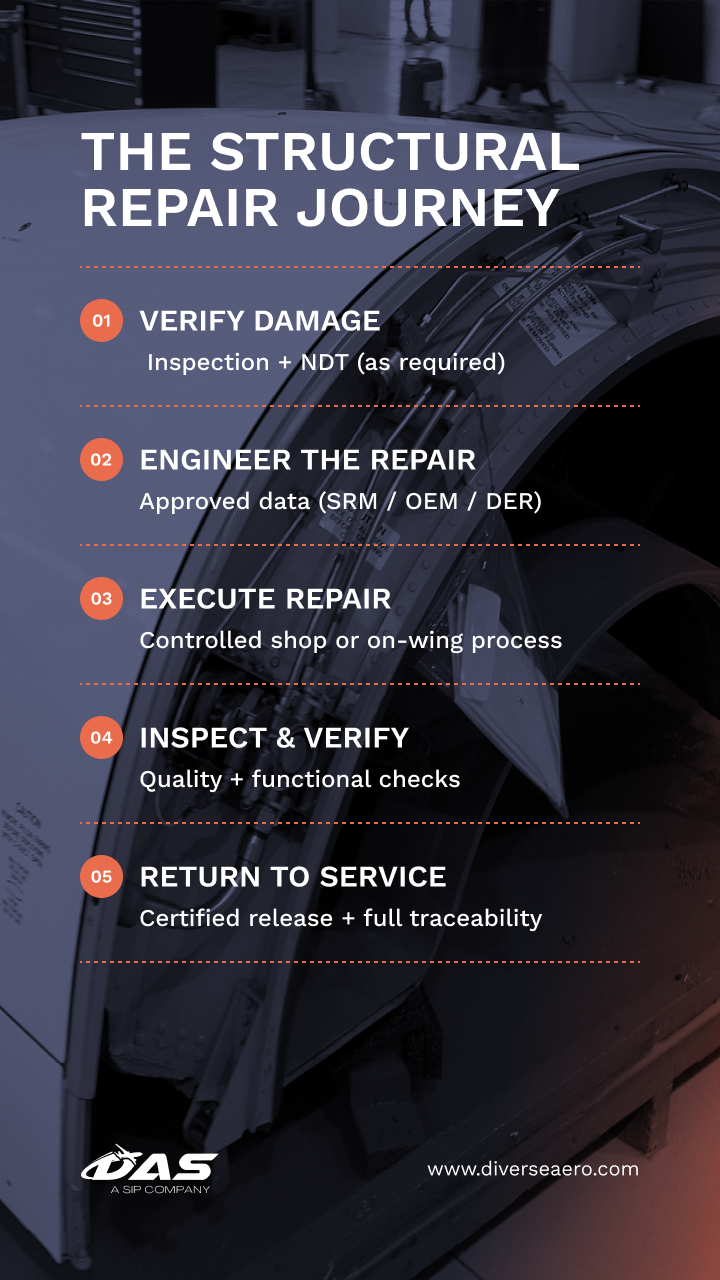
A high-quality structural repair follows a defined sequence of activities designed to ensure technical soundness, traceability, and regulatory compliance.
Technicians confirm the full extent of damage through:
Damage must be accurately characterized in terms of:
Damage classification is not based on appearance alone—it is based on its effect on structural integrity and airworthiness, as explained in how structural damage is identified and classified.
An incomplete or inaccurate assessment at this stage can lead to incorrect repair decisions, rework, compliance exposure, and extended turnaround time.
Engineering teams evaluate repair options using approved data, including:
A key decision is whether to repair or replace, based on:
The repair versus replacement decision is an operational decision informed by engineering—not a purely technical choice.
At this stage, the repair is also classified (e.g., major or minor), which determines:
Repairs may be performed in a controlled shop environment or on-wing (AOG), depending on access, urgency, and regulatory allowances.
Typical repair methods include:
All work is executed under controlled conditions, following approved procedures, tooling requirements, and defined environmental limits.
Environmental control—such as temperature, humidity, and cure monitoring—is a compliance requirement, particularly for composite repairs.
After repair, the structure is inspected and verified in accordance with approved data.
Verification may include:
Quality and inspection personnel ensure that the repair meets all technical and regulatory requirements before release.
Verification is independent of execution and is required to demonstrate compliance—not simply confirm workmanship.
All repair activity must be fully documented, including:
Where applicable, the work is released with an Authorized Release Certificate (FAA Form 8130-3 or EASA Form 1), ensuring full traceability and compliance.
The release form does not make the repair compliant—it certifies that compliance has already been achieved and documented.
Return-to-service (RTS) represents a formal certification that the repaired structure complies with all applicable airworthiness requirements.
This determination is based on:
A structured, engineering-led repair process improves turnaround time (TAT) and operational reliability by:
Most delays in turnaround time are not caused by repair execution itself, but by incomplete damage assessment, lack of approved data, or delayed decision-making.
The way a repair is assessed and executed directly affects schedule predictability, cost exposure, and asset availability.
Structural repair decisions are not isolated technical events—they sit within a broader MRO ecosystem that integrates:
When damage falls outside standard limits, DER-approved repair solutions can provide compliant alternatives to replacement, reducing disruption while maintaining airworthiness.
These solutions are executed within Part 145 MRO services, where inspection, engineering, repair, and certification are tightly controlled.
At the program level, structured repair management aligns engineering, logistics, and documentation to reduce variability in turnaround time.
Consistency in repair outcomes is driven more by process discipline than by individual technical capability.
Equally important is understanding how repairs are classified—particularly the distinction between major and minor structural repairs—which determines approval requirements and regulatory oversight.
1) How long does a structural repair take?
It depends on damage complexity, data availability, and logistics. Localized repairs may take days; complex structural repairs may take weeks.
2) Can you always repair instead of replace?
No. The decision depends on structural limits, approved data availability, and operational constraints.
3) What documentation does the operator receive?
Approved data, inspection, and test records, and an Authorized Release Certificate (FAA Form 8130-3 or EASA Form 1, where applicable).
4) What role does DER play?
DER provides approved engineering data when standard OEM data does not cover the repair, enabling compliant repair solutions.
Aircraft structural repair is a controlled, certifiable process—not a standalone technical intervention.
Its success depends on accurate diagnosis, approved engineering data, disciplined execution, independent verification, and complete documentation.
Need a certified structural repair or engineering review?
DAS combines Part 145 capability with in-house engineering and DER pathways to restore airworthiness efficiently and compliantly.
Contact DAS MRO Team → Start a Repair Request