An MRO procurement strategy is a coordinated, data-driven approach to sourcing, repairing, and managing aircraft components that integrates supply chain orchestration, engineering pathways, repair capacity, and compliance to ensure asset availability and minimize aircraft downtime.
In the current aviation landscape, procurement is no longer just a back-office function—it is a frontline competitive advantage.
As aging fleets face extended service lives and global supply chains remain brittle, a "business as usual" approach to buying parts is a recipe for grounded aircraft and ballooning budgets.
To level the playing field, aviation leaders are shifting from transactional purchasing to a comprehensive MRO procurement strategy.
Shift in aviation procurement:
From reactive purchasing → to predictive, engineering-led asset readiness.
Whether you are managing a small regional fleet or a global operation, these five pillars provide the roadmap to overcoming the industry's most pressing bottlenecks.
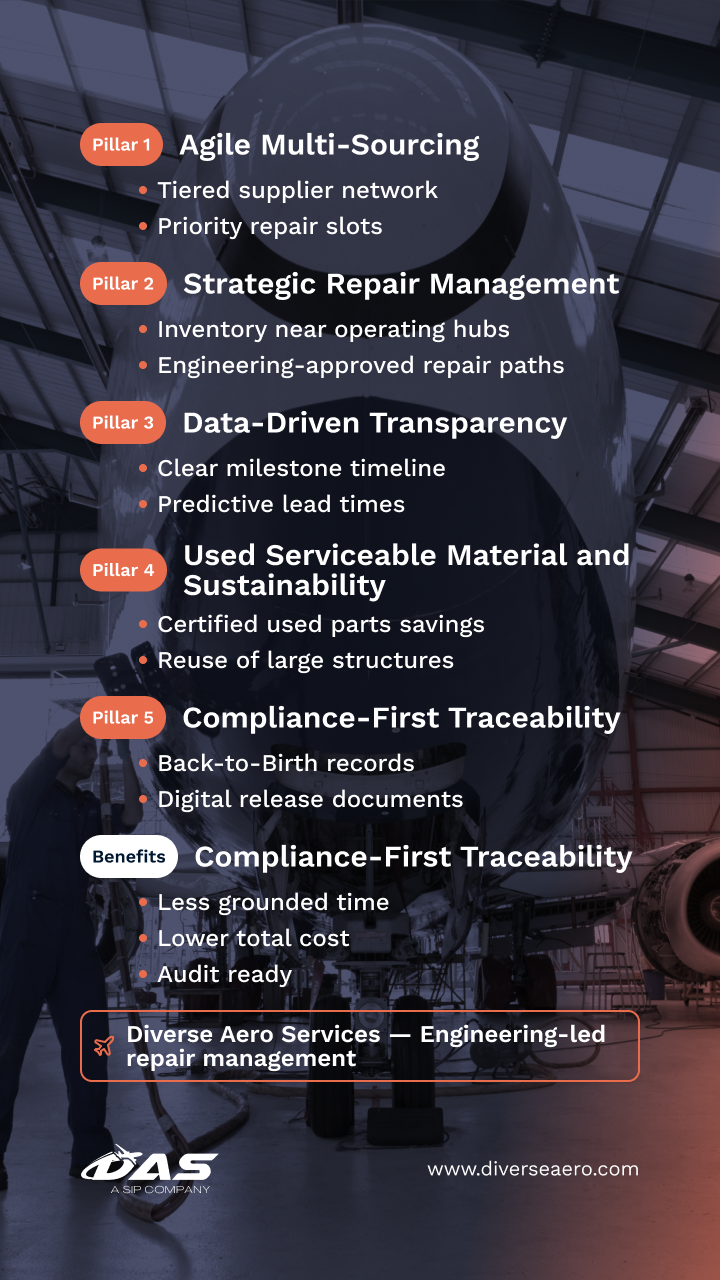
Traditional procurement often relies on static "Preferred Vendor Lists." In a saturated market, if your primary vendor is overbooked, AOG time increases significantly.
An agile MRO procurement strategy introduces Supply Chain Orchestration.
Core principle:
Capacity—not price—is the primary constraint in modern MRO procurement.
While many operators wait in long repair queues, a modern strategy uses Repair Management to create availability.
Instead of reacting to failures, DAS focuses on Asset Readiness.
Explore how this is executed operationally: Repair Management
For how DER enables repair instead of replacement: DER vs OEM: Stay Compliant and On-Schedule
Repair Management = capacity creation
It converts unavailable repair slots into controlled, engineered availability.
In many MRO cycles, the period between induction and shipping lacks visibility.
A modern procurement strategy turns transparency into a financial and operational asset.
Transparency reduces TAT variability
Predictable timelines improve fleet planning more than faster execution alone.
The "OEM Trap" occurs when operators depend exclusively on new parts.
USM (Used Serviceable Material):
Certified aircraft components removed from retired or parted-out aircraft and reintroduced into service with full traceability and airworthiness approval.
In aviation, documentation defines asset value.
For how traceability is managed in repair environments: Structural Repair Traceability in Part 145 Repair Stations
Without traceability, a part has no commercial value—even if technically serviceable.
MRO procurement is not an isolated function—it operates within a broader system that integrates:
Explore service-level integration: MRO Services
For how structural events impact procurement decisions: Structural Aircraft On Ground Repair: Faster, Compliant Return to Service
For how repairs are executed in practice: How Aircraft Structural Repairs Are Performed: From Inspection to Return-to-Service
At DAS, we don’t just move parts—we orchestrate solutions.
We understand that your biggest challenges—lead times, capacity constraints, and cost pressure—require more than a vendor.
They require an integrated, engineering-led strategy.
Q1: How is an MRO strategy different from buying parts?
Traditional purchasing is reactive. MRO strategy is predictive—it orchestrates supply, repair, and availability.
Q2: Is USM reliable?
Yes. Certified USM meets airworthiness standards with full traceability.
Q3: How does Agile Multi-Sourcing reduce delays?
It eliminates dependency on single vendors by accessing distributed repair capacity.
Q4: Why is Back-to-Birth traceability critical?
Without it, parts lose both regulatory validity and commercial value.
Q5: How does DAS solve the capacity gap?
Through DER engineering, repair management, and strategic inventory positioning.
Modern MRO procurement = engineered availability
It combines sourcing, repair, engineering, and compliance into a single system designed to reduce downtime and protect asset value.
Procurement is no longer about buying parts.
It is about controlling:
Operators that adopt an integrated MRO procurement strategy don’t just reduce costs—they gain operational control.