Explains what aircraft structural damage is, why it occurs, and how certified Part 145 MROs detect and characterize it using visual inspection and NDT before any repair decision.
Aircraft structural damage is any condition that compromises—or has the potential to compromise—the load-bearing integrity, durability, or airworthiness of an aircraft structure, whether visible or hidden, and must be evaluated using approved inspection methods before any repair decision is made.
Aircraft structural damage is not a repair problem — it is first a diagnostic problem.
Aircraft are designed to withstand significant operational loads, yet real-world exposure to impacts, fatigue, corrosion, and environmental stresses inevitably leads to structural degradation over time.
Before any repair can be planned, the critical question is not how to fix it, but what exactly is damaged, why it occurred, and how serious it is for airworthiness.
Core principle:
No repair decision is valid until the damage is fully identified, measured, and classified.
This article focuses exclusively on the front end of the process: understanding structural damage — its causes, typical forms, and how certified MROs detect and characterize it using disciplined visual inspection and Non-Destructive Testing (NDT).
Only once damage is clearly defined can a compliant and effective repair pathway be chosen.
Structural damage includes any condition that compromises:
This includes:
In aviation maintenance, damage is evaluated not just by appearance but by its potential effect on:
Key insight:
Damage that appears minor visually can be structurally critical depending on its location and effect on load distribution.
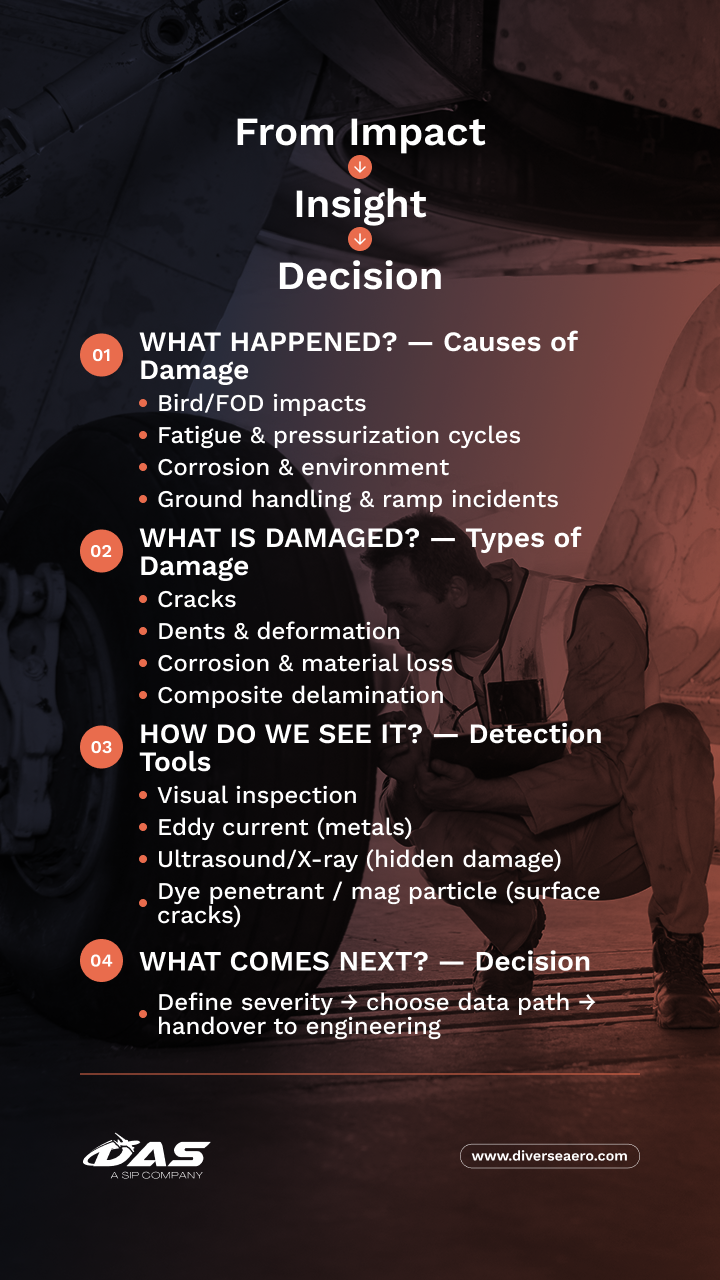
Ground support equipment (GSE), bird strikes, runway debris (FOD), and cargo handling incidents can produce dents, punctures, or internal delamination. These events are a primary source of aircraft dent damage, particularly on exposed surfaces such as fuselage skins and control surfaces.
Pressurization cycles, takeoffs, and landings introduce fatigue cracking, especially around:
Moisture, salt air, de-icing fluids, and temperature fluctuations contribute to structural degradation.
Improper installation or substandard repairs can create latent structural vulnerabilities.
Often initiated by fatigue or impact and capable of propagation if not detected early.
Local deformation—commonly referred to as aircraft dent damage—alters load paths and creates stress concentrations that may affect structural performance.
Pitting, exfoliation, and intergranular corrosion reduce structural strength.
Internal layer separation that typically requires NDT to detect.
Aircraft surface dent damage is a localized deformation of structural skin or panels caused by impact, which may alter load distribution, create stress concentrations, and affect airworthiness depending on depth, location, and structure type.
Aircraft dent damage is one of the most frequent findings during inspections, yet its structural impact is often misunderstood.
Key insight:
Aircraft dent damage is not evaluated by appearance alone—it is evaluated by its structural consequence.
Aircraft dent damage is assessed using engineering criteria—not visual judgment alone.
Evaluation depends on:
In many cases, what appears to be a “small dent” can significantly affect fatigue life or structural behavior depending on where it is located.
Not every dent automatically requires repair.
However, aircraft dent damage becomes structural damage when it:
This makes dent evaluation a critical decision point in aviation maintenance and MRO operations.
Technicians perform structured inspections using:
If damage is suspected or confirmed, MROs apply:
All findings are recorded with:
Damage assessment output:
A complete, measurable map of the defect that defines severity, classification, and the applicable repair pathway.
Critical cases include:
These require immediate coordination with a certified Part 145 repair station.
For how urgent structural events are handled operationally: Structural Aircraft On Ground Repair: Faster, Compliant Return to Service
Once structural damage has been clearly identified and characterized, certified Part 145 repair stations follow a structured process to restore airworthiness.
That workflow is explained in detail here: How Aircraft Structural Repairs Are Performed: From Inspection to Return-to-Service
For how repairs are classified (major vs minor): What Is Aircraft Structural Repair? A Guide to Major vs. Minor Alterations (and Repairs)
Structural damage assessment is the first stage of a broader MRO system that integrates:
Explore how these capabilities connect at service level: MRO Services
For engineering-led repair pathways: DER Repairs
For coordination across logistics and repair execution: Repair Management
No. Aircraft dent damage must be evaluated using engineering criteria. Some dents are acceptable within SRM limits, while others require repair.
Using calibrated depth gauges, dimensional inspection tools, and NDT when internal damage is suspected.
When there is:
It depends on severity, location, and regulatory limits. Some dent damage is acceptable; other cases require immediate grounding.
Certified Part 145 engineers using approved data (SRM, OEM, DER) and validated inspection methods.
Structural damage is a diagnostic problem before it is a repair problem.
Aircraft dent damage clearly illustrates this principle: what appears to be minor surface deformation can carry significant structural implications depending on its context, location, and severity.
Accurate identification and classification determine every downstream decision—repair method, compliance pathway, and return-to-service timeline.
If you suspect structural damage or need a certified assessment, DAS provides 24/7 AOG structural inspection and engineering support from our Miami facility.
Contact DAS Engineering → Request Structural Assessment