Damage to large aircraft structural components can create urgent repair, documentation, and availability decisions for operators.
An inlet cowl may be damaged by ground equipment. A thrust reverser may show internal findings during inspection. A flap, slat, spoiler, or flight control surface may sustain impact, corrosion, delamination, or deformation.
Each case raises a similar question:
Can the component be repaired, or should replacement be considered?
The answer depends on more than visible damage. Large structural components often require specialized handling, inspection, approved repair data, material control, tooling, documentation, and engineering review when applicable.
This article explains the technical and operational challenges involved in repairing large aircraft structural components, including inlet cowls, thrust reversers, flaps, slats, spoilers, and flight control surfaces.
The goal is to help operators understand what makes these repairs complex and what should be evaluated before choosing a repair or replacement path.
Large aircraft structural components are not standard shop items.
They may involve composite structures, metallic structures, bonded assemblies, honeycomb core, fastener patterns, aerodynamic surfaces, load paths, actuation interfaces, and documentation requirements that affect the repair decision.
Specialized structural repair providers are important because these components may require:
For operators, the challenge is often not only finding a shop that can receive the component. The challenge is finding a provider that can help evaluate the damage, explain the repair path, document findings, coordinate inspection requirements, and communicate progress clearly.
That visibility matters when OEM replacement, serviceable used parts, or external repair capacity are limited.
Inlet cowls are part of the nacelle structure and contribute to airflow management around the engine inlet. Damage may involve composite skins, honeycomb core, leading edge areas, acoustic panels, metallic fittings, fasteners, or bonded structures depending on the specific design.
Common repair challenges may include:
Visual inspection may identify the visible damage, but it may not fully characterize internal conditions. Depending on the component, material, and applicable procedure, additional inspection such as ultrasonic testing, tap testing, thermography, or other approved methods may be required.
Composite inlet cowl repairs may involve laminate repair, core repair, bonding, controlled cure conditions, and post-repair inspection. Metallic areas may require corrosion treatment, fastener review, alignment checks, or local structural evaluation.
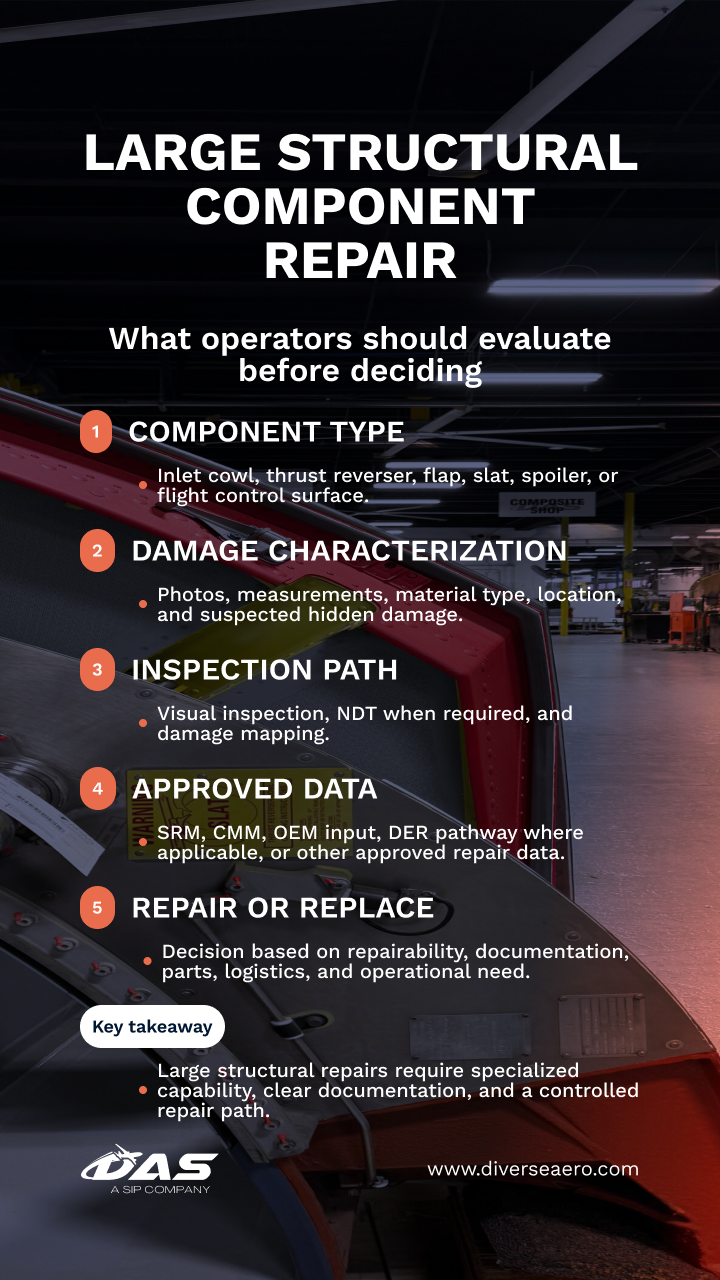
When damage is within applicable limits and approved repair data applies, a defined repair path may be available. When damage exceeds limits or the available data does not apply, engineering review, OEM input, DER-approved data where applicable, or another approved repair pathway may need to be evaluated.
Thrust reversers operate within a complex nacelle environment and may be exposed to significant aerodynamic, mechanical, vibration, and thermal conditions.
They may include composite panels, metallic structures, blocker doors, cascade assemblies, translating sleeves, hinges, fittings, seals, and actuation interfaces, depending on the aircraft and system design.
Repair planning may become complex when damage affects:
A thrust reverser repair must consider not only the damaged area, but also how the component interfaces with the nacelle, engine, actuation system, and operating clearances.
In some cases, approved repair data may define the inspection and repair method. In other cases, additional engineering review, OEM input, DER-approved data where applicable, DOA-approved data in EASA contexts, or replacement may need to be evaluated.
Post-repair checks may include dimensional review, visual inspection, functional checks, NDT when required, and documentation that supports the applicable maintenance and release process.
For operators, the main risk is uncertainty: the repair path can change if teardown or inspection reveals additional findings. Clear communication during this phase helps planning teams understand whether repair remains practical or whether another option should be considered.
Flight control surfaces such as flaps, slats, spoilers, elevators, rudders, and ailerons require careful repair planning because they interact with aerodynamic performance, actuation systems, hinges, fittings, balance, and structural loads.
Damage may involve:
Repairs to flight control surfaces may require attention to contour, balance, weight, stiffness, fastener patterns, bonding quality, and applicable tolerances.
Composite flight control surfaces may require laminate evaluation, ply orientation review, core assessment, controlled repair conditions, and inspection after repair. Metallic surfaces may require crack assessment, corrosion treatment, doubler installation, fastener review, or fatigue-related evaluation depending on the applicable data.
Repairs near hinge fittings, actuator attachments, or load-transfer areas may require additional engineering review because these areas can affect how loads move through the structure.
Operators should also recognize that damage to one surface may trigger inspection of adjacent structures or related systems, depending on the event, approved data, and maintenance procedures.
Large structural component repair starts with understanding the damage.
Before selecting repair or replacement, operators need enough information to characterize the finding. This may include:
Damage mapping helps turn visible damage into technical information that can support repair planning, engineering review, documentation, and communication between the operator and repair provider.
Without clear mapping, the repair decision may be delayed because the team cannot determine whether approved data applies, whether NDT is required, or whether the repair should be escalated.
For large structural components, clear intake information can reduce avoidable back-and-forth before the repair path is defined.
Downtime impact depends on the aircraft, operation, schedule, component availability, repair scope, logistics, documentation, and engineering requirements.
Repair may be appropriate when:
Replacement may be more practical when:
Exchange or serviceable used material may also be considered when available, but those options depend on documentation, compatibility, condition, logistics, and contractual terms.
The decision should not be based only on invoice cost. Operators should evaluate the full operational picture: repairability, inspection findings, approved data, replacement availability, logistics, documentation, and future supportability.
Large structural repairs may be delayed by several factors, including:
Some of these delays are technical. Others are communication-related.
That is why repair visibility matters. Operators need to know where the component is in the process, what findings have been identified, which approvals or data are needed, and what decision is pending.
A specialized structural repair provider should help clarify the repair path, not only perform the work.
Documentation is a central part of structural repair control.
Depending on the work scope, documentation may include:
For large aircraft structural components, documentation matters beyond the immediate repair.
Future inspections, lease transitions, audits, repeat findings, and operator records may all depend on understanding what damage was found, what repair was performed, what data supported the repair, and how the work was documented.
Incomplete documentation can delay acceptance, create audit exposure, or require additional review.
DAS supports operators with structural MRO, large aircraft structural repair, composite and metallic repair capability, DER repair pathway evaluation where applicable, inspection coordination, damage mapping, repair planning, documentation support, and return-to-service support.
For large components such as inlet cowls, thrust reversers, flaps, slats, spoilers, and flight control surfaces, DAS helps operators move from damage identification to a more informed repair decision.
This support may include:
The value is clarity.
When large structural damage is properly characterized, operators can better evaluate the available repair path, understand what documentation is required, and reduce uncertainty before making repair or replacement decisions.
Repairability depends on the component, damage location, material, approved repair data, inspection findings, repair limits, tooling, materials, and documentation requirements. If the available data does not apply, engineering review, OEM input, DER-approved data where applicable, DOA-approved data in EASA contexts, or replacement may need to be evaluated.
Methods may include ultrasonic testing, tap testing, thermography, shearography, or other approved techniques, depending on the structure, material, access, suspected damage mode, and applicable procedure.
Structural repair timelines vary by damage scope, component size, access, approved data, materials, cure requirements, NDT needs, documentation, engineering review, and logistics. No universal timeline should be assumed without evaluating the specific component and damage condition.
Field repairs may be acceptable when the applicable approved data, environmental controls, tooling, access, personnel qualifications, and procedures support the repair. Some complex repairs may be better suited to a controlled shop environment.
Documentation may include repair description, approved data reference, inspection records, NDT results where applicable, material traceability, cure records where applicable, engineering authorization when required, final inspection, and release documentation.
Large aircraft structural component repair requires technical precision, approved data, documentation discipline, and clear communication.
Inlet cowls, thrust reversers, flaps, slats, spoilers, and flight control surfaces can involve composite structures, metallic repairs, aerodynamic contours, bonding, NDT, engineering review, and traceable documentation.
For operators, the challenge is not only deciding whether to repair or replace. It is understanding what information supports that decision, what approved data applies, what documentation is required, and whether the repair path fits the operational need.
DAS supports operators by helping evaluate large structural component damage, coordinate inspection and repair planning, support documentation, and assess DER repair pathways where applicable.
Need support with a large aircraft structural component repair? Contact DAS with aircraft type, component type, damage location, photos, measurements, available repair data, and urgency level.