Major structural damage creates operational pressure because repair decisions may involve engineering review, approved repair data, documentation requirements, and coordination between the operator, repair station, and approval authority where applicable.
A major structural repair is not only a technical event. It is also a controlled approval and documentation process. Before work can move forward, the operator and maintenance provider must understand the damage, determine the applicable repair classification, identify the correct approved data, and confirm the oversight required for execution and return to service.
This guide explains how operators can approach major structural repair approval, documentation, and oversight in a disciplined way.
Not every structural finding becomes a major repair. The classification depends on the type of damage, its location, the affected structure, the repair method, and the applicable regulatory criteria.
In FAA contexts, 14 CFR Part 43 Appendix A identifies major repairs as including repairs to primary structural members and specific airframe parts when the work involves strengthening, reinforcing, splicing, or fabrication such as riveting or welding. Examples include box beams, monocoque or semimonocoque wings or control surfaces, wing stringers, spars, and spar flanges.
Structural damage may require major repair classification or engineering review when it affects:
The decision should not be based only on how the damage looks. A dent, crack, impact mark, corrosion finding, or deformation may require further evaluation when its location or depth affects structural integrity.
If the damage is covered by existing approved repair data, the repair path may be clearer. If the damage is outside published limits or the available data does not apply, further engineering review, OEM input, DER/ODA-approved data where applicable, DOA-approved data in EASA contexts, or another approved repair pathway may be required.
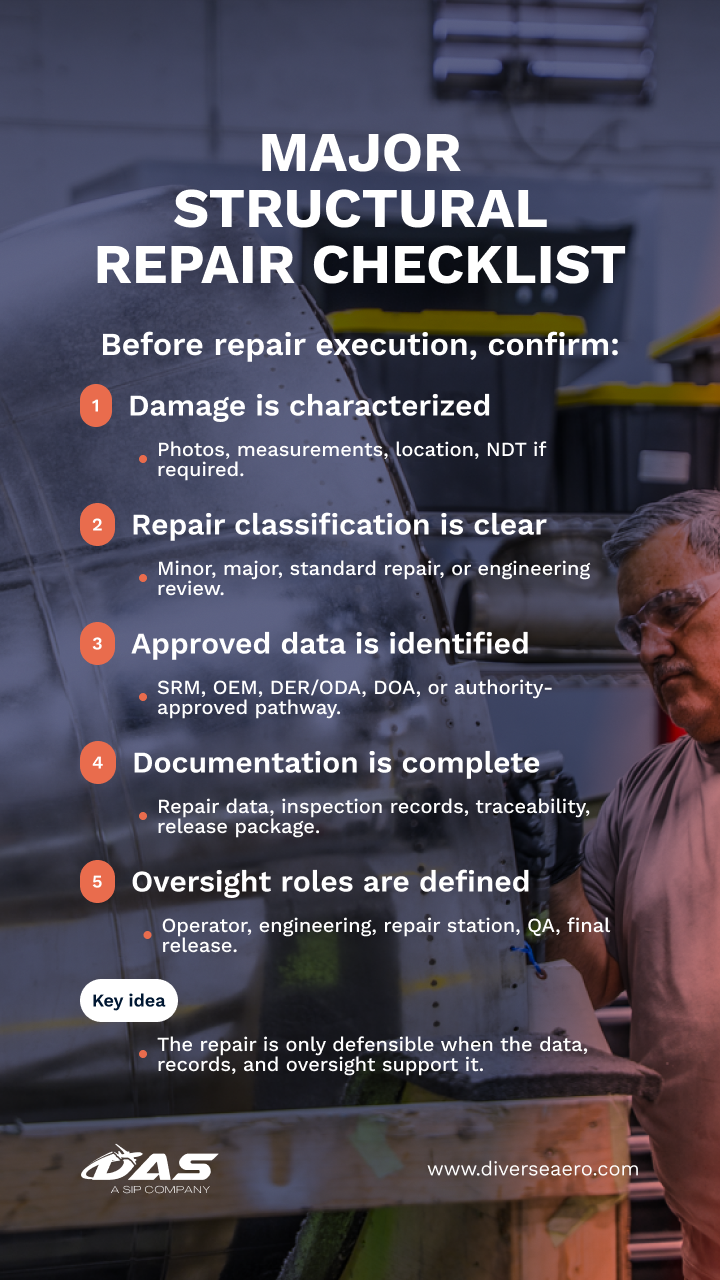
Major structural repairs require approved data and authorized execution.
The approval path depends on the aircraft, operator, regulatory environment, type of damage, available repair data, and repair station scope.
Approved data may come from several sources, including:
FAA AC 43-210A provides a standardized procedure for requesting approval of technical data associated with major repairs and major alterations, and also provides guidance on determining when a proposed repair or alteration requires approved data. The FAA notes that this AC is not mandatory and does not constitute a regulation. (Federal Aviation Administration)
A Part 145 repair station may perform and release work within its approved scope when approved data, ratings, qualified personnel, tooling, procedures, and inspection requirements apply. However, approval of the repair data itself may require OEM, DER/ODA, DOA, or authority-approved data depending on the specific context.
The safest way to think about the framework is this:
Major structural repair approval is not one single route. It is a controlled pathway based on approved data, repair classification, organizational privileges, and documentation.
When major structural damage is found, operators often need to decide whether to repair, replace, or escalate for further engineering review.
That decision depends on technical, operational, and commercial factors.
Repair may be considered when:
Replacement may be required or more practical when:
The decision should not be reduced to cost alone. Structural repair decisions must consider approved data, structural integrity, inspection findings, documentation, aircraft availability, parts lead time, repair capability, and operator procedures.
A repaired item may be acceptable for return to service when it is repaired, inspected, documented, and released under approved data and applicable procedures.
Documentation is central to major structural repair control.
For structural repairs, the records should show what damage was found, how it was assessed, what approved data was used, how the work was performed, what inspections were completed, and how the repair was released.
Depending on the regulatory context and work scope, documentation may include:
For FAA-regulated work, FAA Form 337 may be required for major repairs depending on the aircraft, work scope, and applicable Part 43 recording requirements. 14 CFR Part 43 Appendix B states that, except for listed exceptions, each person performing a major repair or major alteration must execute FAA Form 337 at least in duplicate and give a signed copy to the aircraft owner.
For EASA contexts, EASA Form 1 should be used carefully in the article. EASA describes Form 1 as an Authorised Release Certificate for stating that a product, part, or component was manufactured in accordance with design data, and notes that the same form is suitable for maintenance organization use. It should not be described as a universal aircraft-level release document. (EASA)
The distinction matters:
Aircraft-level release and component-level release are not always the same documentation process.
Incomplete documentation may delay release until required records, inspection results, approvals, and release documentation are completed or verified under the applicable procedures.
FAA and EASA frameworks differ in how repair data is approved, how maintenance is released, and how records are maintained.
In FAA contexts, major structural repair control may involve:
In EASA contexts, the process may involve:
For operators managing cross-border fleets, mixed registries, or lessor requirements, these distinctions can affect documentation planning. The safest approach is to confirm the applicable authority, aircraft registration, repair data source, maintenance organization privileges, and release documentation before the repair begins.
This helps reduce friction at the end of the repair, when missing or incorrect records can create delays.
Major structural repairs require coordination between several functions.
Oversight may involve:
Engineering defines the repair data, materials, inspection criteria, allowable limits, and any required follow-up actions. Depending on the regulatory context, this may involve OEM engineering, DER/ODA-approved data, DOA-approved data, or authority-approved data where applicable.
The repair station performs the work within its approved scope using approved data, qualified personnel, tooling, materials, and documented procedures.
Quality teams and authorized inspectors verify that work is performed according to approved instructions, that required inspections are completed, and that records support the maintenance action.
The operator remains responsible for continuing airworthiness. Depending on the regulatory structure, continuing airworthiness, maintenance control, engineering, or CAMO functions may need to review repair status, records, and operational impact.
Final release depends on the applicable regulatory framework, organizational privileges, work scope, and documentation. The release should confirm that the maintenance action was completed according to approved data and required inspections and records are complete.
Clear roles reduce rework, prevent documentation gaps, and help the operator maintain visibility throughout the repair cycle.
Major structural repairs can be technically complete but still delayed because documentation is incomplete or inconsistent.
Common gaps include:
These gaps create risk during audits, lease transitions, repeat inspections, and return-to-service review.
For operators, documentation should be treated as part of the repair process, not an administrative step after the repair is done.
For DAS, major structural repair support is not only about executing the physical repair. It is about helping operators move through a controlled process: damage assessment, inspection, documentation, approval pathway, repair planning, execution, and release support
DAS supports operators by helping organize the technical and documentation flow around structural repair decisions.
This may include:
The value is clarity. When the damage is properly characterized, the repair data is identified, roles are clear, and documentation is complete, operators can make more defensible maintenance decisions.
A Part 145 repair station may perform and release work within its approved scope when approved data, ratings, qualified personnel, tooling, and procedures apply. Approval of the repair data itself may require OEM, DER/ODA, DOA, or authority-approved data depending on the regulatory context and repair scenario.
Timeline varies depending on damage complexity, availability of approved data, engineering review, inspection requirements, documentation, repair station capacity, and authority or approval pathway involvement where applicable.
Incomplete documentation may delay release until required records, inspection results, approvals, and release documentation are completed or verified under the applicable procedures.
No. DER approval is not always required. Some repairs may be covered by OEM or existing approved repair data. Others may require DER/ODA-approved data, DOA-approved data, authority approval, OEM input, or replacement, depending on the regulatory framework and repair scenario.
Damage mapping helps show the location, dimensions, orientation, and structural relevance of the finding. This supports engineering review, repair data selection, inspection planning, and documentation continuity.
Major structural repairs require more than a physical repair solution.
They depend on approved data, repair classification, engineering review where required, documented execution, inspection control, and release procedures.
For operators, the priority is to make the repair decision defensible: identify the damage accurately, choose the correct approval pathway, execute the repair under the applicable data, and maintain complete documentation.
For DAS, the role is to support that process through structural repair capability, inspection coordination, damage mapping, documentation discipline, and DER pathway evaluation where applicable.
A disciplined approval and documentation process helps operators reduce uncertainty, protect structural integrity, and support return-to-service decisions under applicable procedures.