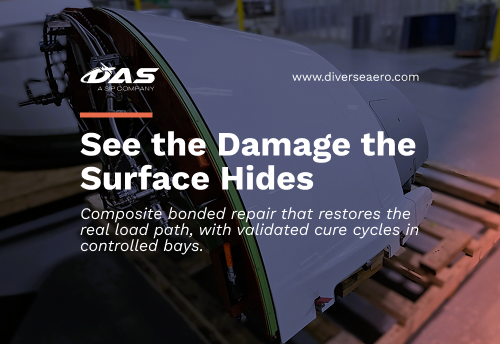
Composite structures do not fail the way metal does. There is no obvious dent, no visible crack to chase — the damage often hides beneath an intact-looking surface as delamination or disbond, quietly interrupting the load path.
Understanding how composite bonded repair works is the difference between a durable, engineered fix and a cosmetic patch that never restores the structure's real strength.
A composite laminate carries load through fibres held in a matrix and — in bonded assemblies — through the adhesive bond between plies or skins.
When that internal architecture is disrupted, the surface can still look sound while the structure has lost its ability to transfer load.
That is why composite inspection relies on more than the naked eye, and why a repair has to address what is happening inside the laminate, not just on top of it.
The two conditions operators hear about most are delamination — a separation between the layers of a laminate — and disbond, a separation at a bonded interface such as skin-to-core or skin-to-doubler.
Both interrupt the path that load is supposed to follow, and both need to be fully mapped before any repair begins.
Delamination is a separation within the layered stack of the laminate.
It often follows an impact — a dropped tool, ground equipment contact, hail — where the energy travels through the part and pulls plies apart internally. The surface may show little or nothing, yet the affected zone no longer shares load with the plies around it.
A disbond is a loss of adhesion at a bonded joint.
In a sandwich panel it typically means the skin has separated from the core; in a solid laminate it can mean a doubler or repair has released.
Left in place, either condition can grow under service loads and moisture. The goal of composite structural repair is to remove the compromised material and re-establish a continuous, load-bearing structure.
The whole point of a composite bonded repair is to give load a continuous route through the structure again.
That means removing damaged plies or debonded material, preparing the surrounding laminate precisely, and rebuilding it so the repair carries its share of load in and out of the surrounding structure.
A repair that only fills or covers the damage restores appearance, not strength.
Doing this well requires control over the whole process: clean and accurate removal of damaged material, correct ply orientation and stacking so fibres align with the loads, proper adhesives and materials, and a controlled cure.
Each of those steps affects how the repaired zone shares load — and skipping the discipline on any one of them undermines the rest.
A composite repair only reaches its intended strength if the resin and adhesive cure correctly, and that depends on tightly controlled conditions.
A validated cure cycle means the temperature and time profile has been established and verified for the material and repair — so the bond develops the properties the engineering assumed.
Environmental control is not a nicety here. It is a requirement.
DAS performs bonded and bolted repairs using validated cure cycles in dedicated structural bays, with environmental controls for temperature and humidity during composite curing.
That controlled environment keeps contamination and moisture from compromising the bond, and lets the repair achieve consistent, repeatable results.

Metal repairs are largely mechanical. You cut back to good material and fasten or weld a doubler, and the result is visible and easy to inspect.
Composite repair is a materials-and-process discipline. The strength lives in the bond and the laminate, which are only as good as the surface preparation, material handling, ply layup and cure that created them.
That is why process control and engineering matter so much more on composites.
It is also why composite repairs frequently need engineering support. When damage exceeds what the manual covers, restoring the load path may call for an engineered, substantiated repair.
With in-house engineering and DER-based support, DAS can take a composite repair beyond standard limits when the structure warrants it — and confirm honestly when a part should be replaced instead.
DAS specializes in aircraft structures, sheet metal and advanced composites at its Miami facility.
Its composite scope covers panels, fairings, nacelle components (fan, inlet, cowls, thrust reversers), control surfaces, radomes, winglets and ducts — the assemblies where delamination, disbond and impact damage most often appear.
Repairs are performed bonded or bolted, with validated cure cycles, in dedicated structural bays under controlled temperature and humidity.
To start, send the damage description or report, drawings and photos, part or component identification, and the aircraft application.
DAS reviews the condition, defines the extent of the delamination or disbond, and confirms the repair path — using in-house engineering and DER support when the damage runs beyond the SRM.
An aircraft composite repair restores the structure's internal load path by removing damaged plies or debonded material and rebuilding the laminate under controlled conditions. Unlike a cosmetic patch, it re-establishes strength and durability, not just surface appearance.
Delamination repair starts by mapping the full extent of the separation, then removing the affected plies and rebuilding the laminate with correct orientation, proper adhesives and a validated cure cycle, so the repaired zone shares load with the surrounding structure again.
Delamination is a separation between the layers within a laminate, while disbond is a loss of adhesion at a bonded interface such as skin-to-core. Both interrupt the load path, and a composite bonded repair addresses each by restoring a continuous, load-bearing structure.
A composite bonded repair only reaches its intended strength if the adhesive and resin cure under controlled temperature and time. A validated cure cycle, performed with environmental controls, ensures the bond develops the properties the repair engineering relies on.
Composite versus metal repair comes down to process control: metal repair is mechanical and easy to inspect, while composite structural repair depends on surface prep, layup, materials and cure. That is why composites often need engineering support and controlled bays to restore full strength.