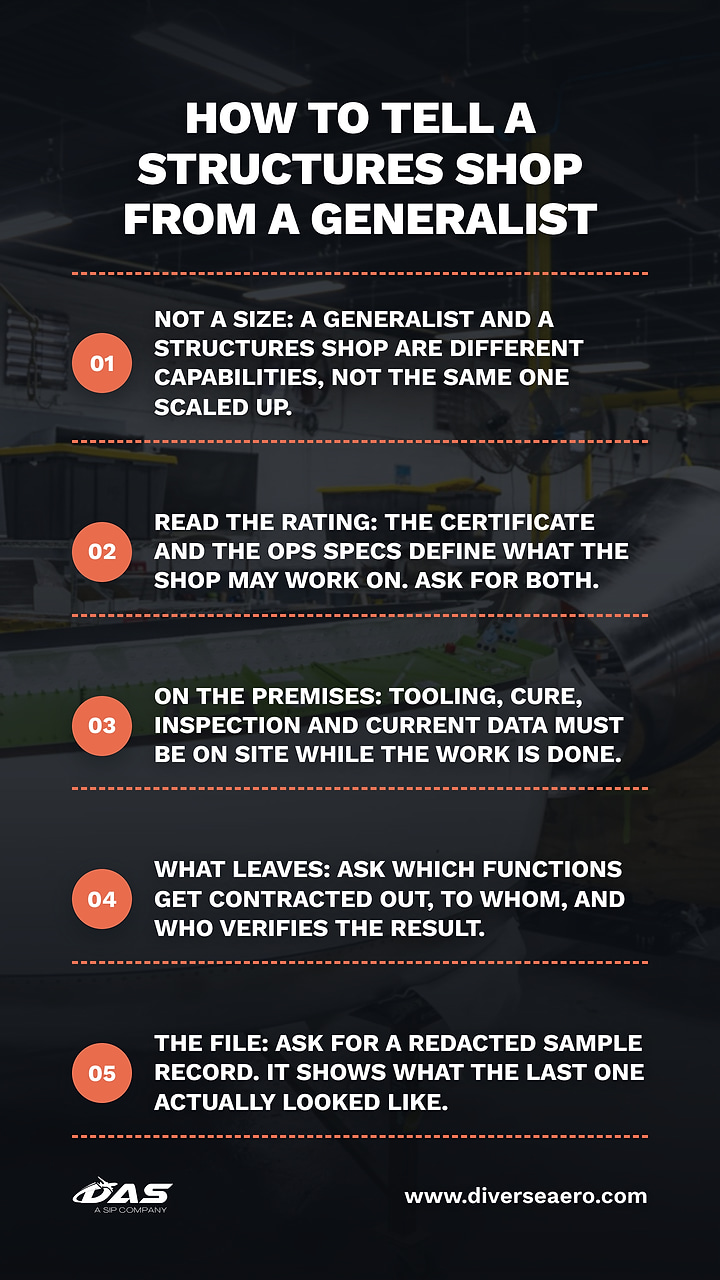
Qualifying a structural repair station means establishing, before you send anything, whether a shop can carry a damaged load-bearing part from evaluation through to a release you can defend — with the rating that covers it, the means physically on site, and the engineering to handle damage the manual does not. It is not a size question. A generalist repair station and a structures shop are not the same capability at different scales; they are different capabilities, and the gap shows up on the parts that are hardest to replace.
That assumption usually survives right up until a nacelle cowl, a flight control surface or a fuselage section comes back with an incomplete file, or does not come back on time because the work went somewhere the shop never mentioned. All four checks below can be made before that happens.
Four things, and all four are checkable in advance. The rating on the certificate, which defines what the shop is authorized to work on. The means physically present on site — tooling, geometry fixtures, cure capability, inspection. The engineering available when damage exceeds published limits. And the documentation the shop issues at the end, which is what the work is worth in two years.
A generalist station can be excellent at what its rating covers. The mismatch appears when a structural component arrives that needs geometry held to a drawing, a controlled cure, level III inspection and an engineered repair — and three of those four have to be sent elsewhere. It shows up most sharply on large structural components, which are slow and expensive to replace.
Start with what the authority certificated, not with whatthe website says.
Under US rules the airframe ratings are defined narrowly and usefully: Class 1 covers composite construction of small aircraft, Class 2 composite construction of large aircraft, Class 3 all-metal small aircraft and Class 4 all-metal large aircraft. A shop working large transport structure in composite and metal should hold ratings consistent with that work. A limited rating, which authorizes work on specific makes and models or specific articles, is also perfectly legitimate —but it is limited, and the scope is written down.
What this gives you is a two-minute check with a real answer. Ask for the certificate and the operations specifications, and read what the ratings actually cover against the part you intend to send. A shop that is comfortable showing both is telling you something before it says a word.
This is the question that separates a structures capability from a coordination service, and the regulation is unusually direct about it.
A certificated repair station must have the equipment, tools and materials needed to perform the work under its certificate, and those must be located on the premises and under the repair station's control when the work is being done. Inspection equipment used to make airworthiness determinations must be calibrated to a standard acceptable to the authority. And the data —airworthiness directives, maintenance and overhaul manuals, standard practice manuals, service bulletins — must be current and accessible while the work is happening.
For structural work, translate that into a list you can walk past:
· Tooling and fixtures that hold the part's geometry while it is worked, not a bench and a clamp
· Cure capability appropriate to the repairs on offer, with recorded cycles
· Nondestructive inspection on site, with the methods the parts actually need
· Sheet metal and precision forming means formetallic structure
· Controlled areas for bonding, with the environment actually controlled
· Current revisions of the applicable structural repair manuals for your fleet
That list is also the right lens for reading any shop's structural repair capabilities page: look for the means named, not the adjectives.
Subcontracting is legitimate and universal. What matters is whether you know about it, and where the accountability sits.
A repair station may contract a maintenance function to an outside source, but the authority has to approve the function being contracted, and the station must keep available a list of which functions go to which facility, and what certificate each holds. Where the outside source is not certificated, it must follow an equivalent quality system, the repair station stays directly in charge, and it must verify by test or inspection that the work was done properly before approving the article for return to service. The rule also closes the obvious loophole: a repair station may not provide only the approval for return to service after contract maintenance on a complete product.
So the useful question is not "do you subcontract?" Everyone does something. It is: which functions on my part would leave your premises, to whom, and who verifies the result? That answer tells you where your turnaround time really lives.
Two clarifications, because both get misread. "Manufacturer" is not a regulatory tier — what makes a repair acceptable is approved data and a valid release, whoever produced them. And nothing in that table is a cost argument: the reason to repair a structural component rather than replace it is a technical judgment about admissible limits, and it stops being defensible the moment it is argued as a discount.
Put these to any shop before a structural component leaves your line. They take one call.
1. What ratings does your certificate carry, and what do your operations specifications cover for this aircraft class?
2. Which structural repair manuals do you hold current for my fleet, and at what revision?
3. Which of the means this repair needs are on your premises — tooling, cure, inspection, forming?
4. What nondestructive inspection methods do you perform in house, and at what personnel qualification level?
5. If the damage exceeds manual limits, what is your route to approved engineering data ,and how long does that route typically take?
6. Which functions on this part, if any, would becontracted out, to whom, and who verifies the result?
7. What exactly will the finished file contain, andcan you show me an example with the identifying details removed?
8. Who holds the accountability for the release —your station, or the facility that did the work?
Question seven is the one that changes conversations. A shop that can hand you a redacted sample file already knows what a complete record looks like. A shop that has to go and assemble one is telling you how the last file was built.
A structural repair is irreversible and it stays with the aircraft for the rest of its life, which is why the file is not administration that follows the work — it is part of the work. The completed package should let a stranger reconstruct the whole sequence, from inspection to return to service — what was found, what was done and what authorized it: the damage report and inspection results, the repair scheme and the data reference it was approved under, materials and batch traceability, process records, the post-repair inspection, and the release. What that file has to survive is covered in structural repair traceability.
Qualifying a shop is, in the end, a documentation exercise disguised as a technical one. The technical capability determines whether there pair can be done. The record determines whether it will still count years from now.
An MRO is a business description; a repair station is a certificate. In the US, a repair station is certificated under Part 145, and its ratings define what it may maintain or repair. A company marketed as an MRO may hold that certificate, rely on other organizations' certificates, or both, so ask which certificate covers your part.
Ask for the certificate and its operations specifications, then cross-check them with the FAA, which publishes a searchable list of certificated repair stations by name, location and rating. Both should match the work you intend to send. A rating that does not cover your aircraft class or your part is an answer in itself.
In practice, yes. Under the US-EU aviation safety agreement, a repair station certificated under Part 145 can be issued an EASA certificate when it shows the approval is needed to maintain products registered or designed in an EU member state. If your fleet includes European-registered aircraft, ask for both approvals and their scope.
Have a structural component you need evaluated? Talk to our team and send the damage report and we will tell you what the repair route looks like.