Approved repair data is engineering that an authority has accepted as a valid basis for putting a damaged structure back into service. The structural repair manual(https://www.diverseaero.com/post/structural-repair-manual-srm-aviation)is one form of it — pre-substantiated, published by the manufacturer, and covering the damage the designers anticipated. When damage falls outside what that manual covers, the repair has not been refused. The document that would have authorized it simply does not extend that far, and the decision moves from the shop floor to engineering.
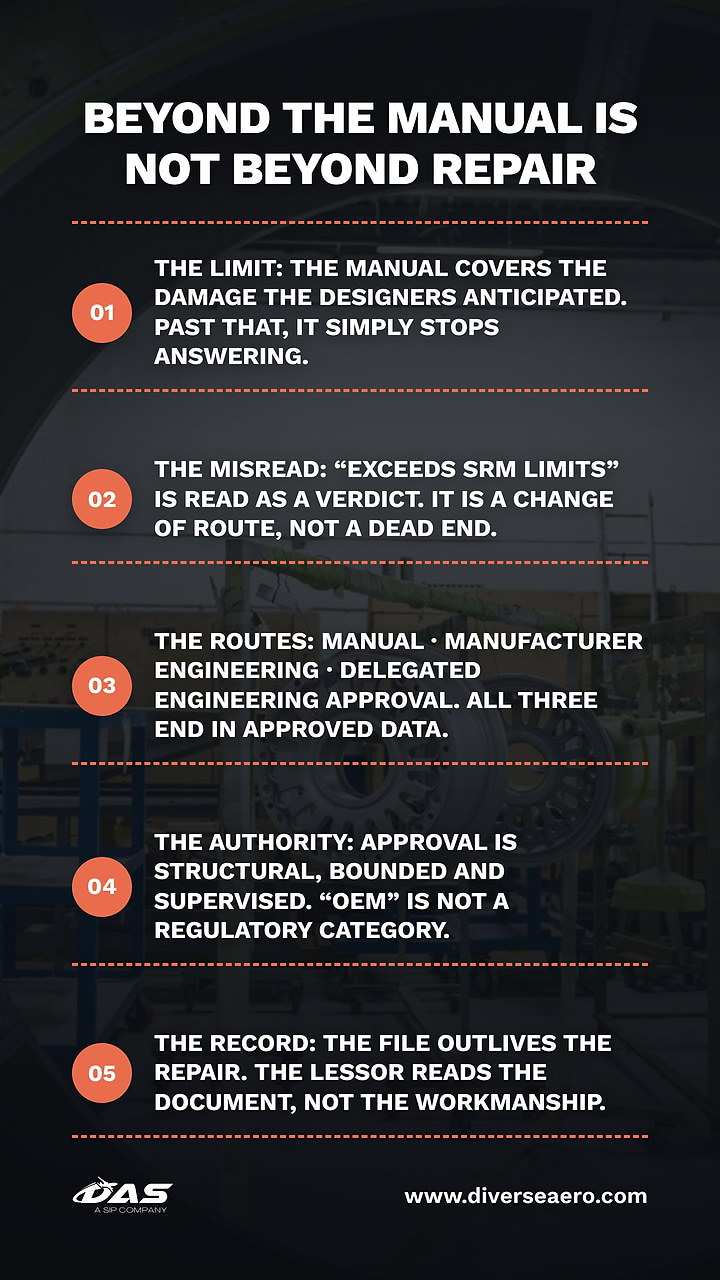
That distinction is where a great deal of money is lost every year. A disposition that reads "exceeds SRM limits" is regularly treated as a verdict, and the next call is to a parts desk, with a lead time nobody in the conversation controls. It is not a verdict. It is a change of route, and the routes are worth knowing before you need one —starting from how the damage was measured against published limits in the first place.
The manual stops being the authority and an engineering evaluation begins. Someone has to determine whether a repair can be designed for that specific damage, on that specific part, and substantiated to the standard the original structure was certified to. If it can, the repair proceeds under approved engineering data instead of a published scheme. If it cannot, replacement is the answer — but that conclusion is an output of the evaluation, not a substitute for it.
The evaluation is not a formality, and the aviation authority's own guidance says as much. Operators and repair organizations working outside the scope of approved repair documentation are warned to expect extensive analysis, design, process and test substantiation before a repair on certificated structure can be accepted. That is the real cost of going past the manual: engineering effort, not permission.
One clarification, because it causes real confusion: "OEM" is not a regulatory category. It describes who made the part, not a class of approval. A repair backed by the manufacturer and a repair backed by delegated engineering are both accepted on the same basis — that the data behind them was approved by an authority, or by someone the authority delegated to. The question worth asking is never "is this OEM?" It is "who approved this data, within what limits, and what document proves it?" That comparison is taken apart in DER and OEM repair data: who approves what.
In the United States, the delegation is written into regulation. A structural engineering representative may approve structural engineering information within limits prescribed by, and under the general supervision of, the Administrator, whenever that representative determines the information complies with the applicable regulations.
Three things in that sentence do most of the work. The approval is structural — a representative delegated for structures approves structural data, not everything. It is bounded: the limits are prescribed in advance, not negotiated per job. And it is exercised under supervision, which is what makes the resulting approval an authority's approval rather than a private opinion. Applied to airframe structure, that is the route described in engineered structural repairs.
European operators work through a parallel logic under EASA rules, where a major repair design is approved by the authority or by an appropriately approved design organization. The mechanism differs; the principle does not. Somebody with delegated authority, working inside a defined scope, accepts the engineering.
A repair beyond the manual produces more paperwork than oneinside it, and the paperwork is the part that survives.
Under US rules, a major repair is recorded on FAA Form 337,executed at least in duplicate, with a signed copy to the aircraft owner and a copy forwarded to the FAA within 48 hours of the approval for return to service. There is an alternative for repairs made in accordance with a manual or specification acceptable to the Administrator: a certificated repair station may instead use the customer's work order, give the owner a signed copy and a maintenance release, and retain a duplicate for at least two years.
Two practical consequences follow. First, the route chosen changes what the file looks like, so it is worth agreeing on the record form at before the work starts rather than after. Second, whichever route applies, the approved data reference has to be traceable from the record to the document that authorized it. A release that names no data is a release that will be questioned. Our article on structural repair traceability covers what a complete file contains.
This is the question operators actually carry, and it rarely gets a straight answer.
A lessor's technical team reviewing a return package is not assessing the engineering. It is assessing whether the repair is documented well enough to be understood by someone who was not there. That means the approved data reference, the scope of the approval, the repair scheme, the materials and their traceability, the inspections performed, and the release —as a set, consistent with each other and with what is physically on the aircraft.
Repairs get challenged at return for reasons that are almost always documentary. The data reference is missing or points to a revision that has moved. The repair on the aircraft does not match the drawing on file. The approval exists but its scope is not evident from the paperwork. The record was made under one route and the work was performed under another.
None of that is about whether delegated engineering is acceptable. It is acceptable. It is about whether your file can demonstrate, years later and to a stranger, what was done and what authorized it. That is the case worth building while the aircraft is in the shop, not while it is being handed back. What a return package has to withstand is covered in our guide to lease return documentation.
Sometimes it is, and saying so is part of the discipline.
Damage that has removed too much load-carrying material, damage in a location where no repair scheme can restore the load path within the certified envelope, damage compounded by previous repairs that have consumed the available margin, or damage on a part where the engineering effort exceeds any reasonable return — these are real outcomes. The difference is that they are conclusions reached after an evaluation, supported by the analysis that reached them, rather than an assumption made when a measurement crossed a line in a manual.
That is the only claim worth making about structures at this border: the manual tells you where pre-approved answers stop. It does not tell you where repair stops.
Holding a disposition that says the damage exceeds manual limits? Send it over and we will tell you whether an engineered repair is available for it.