"Approved" is not a property of a material. It isa property of a combination: this material, processed this way, for this repair, under data that authorizes all three together. A filler that is fully approved for a cosmetic contour restoration on one panel is not approved for a structural repair on the next one, and nothing about the can has changed. Once that is clear, most of the confusion around aviation composite fillers, adhesives and repair materials resolves itself.
The practical version of the problem sounds like this: a shop needs a material, finds one that matches the description in the repair scheme, and assumes equivalence. Equivalence in aviation composites is a demonstrated thing, not an apparent one. What follows is what each family of material actually does, and what has to travel with it.
It means the material has been qualified against a specification, is processed under a specification, and is named in data that authorizes its use for that repair. Three documents, not one. The material specification controls what arrives. The process specification controls what happens to it. The repair data ties both to a specific damage on a specific structure. Remove any of the three and the material is just a product with good properties.
Aviation authority guidance on composite structure is explicit about the first two. Composite materials and processes are qualified through enough fabrication trials and tests to demonstrate a reproducible and reliable result; material specifications exist to ensure consistent material is procured, with batch acceptance testing or statistical process control used so that properties do not drift over time. Both test parts and production parts must conform to those specifications.
Four material families appear in almost every composite repair scheme, and our composite repair decision guide sets out where each one sits in the wider repair decision.
This is the single most useful distinction on the list, and it is where a repair most often goes quietly wrong.
Filler exists to return a surface to its aerodynamic contour and to close small defects that would otherwise trap moisture or initiate further damage. That is a real function, and a repair scheme that calls for filler is calling for it deliberately. What filler does not do is carry the load that the removed or damaged plies used to carry. A depression filled and faired looks finished. If the laminate underneath lost plies, the structure has not been restored — it has been concealed. The same gap drives delamination and disbond: what the surface shows and what the laminate has lost are two different quantities.
The test is simple enough to apply in a quoting conversation: ask what the scheme expects the filler to restore. If the answer is contour, it is the right material. If the answer includes strength, the scheme needs laminate, not filler.
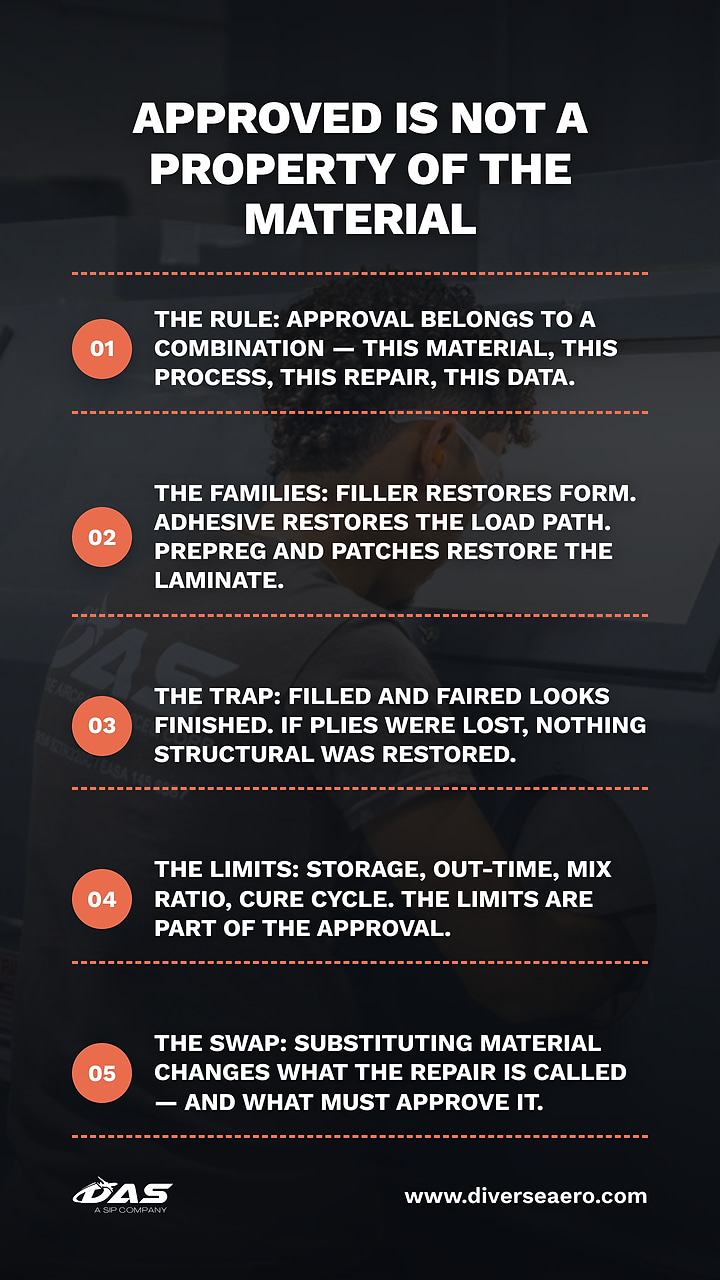
An adhesive or a prepreg arrives with limits attached, and those limits are part of the approval rather than a manufacturer's suggestion.
Storage temperature. Shelf life. Out-time — the cumulative time the material has spent out of freezer conditions, which for prepreg is tracked because it consumes the material's ability to cure properly. Mix ratio and pot life for two-part systems. Surface preparation before the bond. The cure cycle itself: temperature, ramp rate, dwell, pressure, and the record proving that the part experienced them rather than the controller reporting them.
Authority guidance frames this as establishing processing tolerances, material handling and storage limits, and key characteristics that can be measured and tracked to judge part quality. It also notes that once fabrication processes are established, changes should not occur unless additional qualification, including testing of the differences, has been completed.
That last point is the one that catches shops out. A material change that looks minor — a different supplier for the same generic product, a revised formulation, a substituted adhesive with equivalent published properties — is not automatically covered by the existing data. It isa change that has to be qualified before it is used.
It changes what the repair is called.
Under US rules, a repair involving the substitution of material is listed as an airframe major repair, alongside repairs to spars, ribs, stringers and other primary members. A shop that substitutes a material because the specified one was unavailable has not made a procurement decision. It has changed the classification of the repair and, with it, the approval and the record that has to follow.
Where the substitution is necessary and defensible, the route is the same one that applies to any damage outside published data: the substitution gets substantiated and approved before it is used, not explained afterward. How that route works is covered in our article on what happens when damage exceeds the manual.
Material and method are not separate decisions, which is why this conversation belongs alongside the one about repair type.
A bonded repair leans on adhesive and, usually, on prepreg or a precured patch, and inherits every process control the bond line demands. A bolted repair leans on the doubler, the fastener standard and the sealant, and inherits a different set. Which of the two applies is decided by the damage itself, as covered in bonded or bolted composite repair — and the material list follows from that, not the other way around.
Durability is the question operators ask next: whether are paired laminate performs like the original over time. It is a substantial subject in its own right and it depends on the repair type, the environment and the inspection regime, so it sits outside this article rather than being compressed into a paragraph.
· Which specification is the material qualified against, and does the repair data name it
· What is the batch, and what batch acceptance evidence exists
· What are the storage and out-time limits, and how are they tracked on this job
· What cure cycle does the process specification require, and how is it recorded
· If the specified material is unavailable, what is the substitution route, and who approves it
· What will the finished record show for materials and traceability
The shop that can answer those six questions before the work starts is the one that will still be able to answer them in four years, when someone reviews the file during a lease transition.
Yes, where the original structure had it. FAA guidance on composite structure names the lightning strike protection system among the surface layers that must also be properly repaired. In practice, the conductive layer belongs on the repair's material list, with its own specification and record, rather than being treated as a finishing step.
More than it seems. Paints and coatings protect composite structure against ultraviolet exposure and high structural temperatures, and FAA guidance expects maintenance manuals to include repainting instructions, with restrictions on paint colors that raise structural temperatures. A repair finished in the wrong coating or color can remove protection the laminate depends on.
Not by default. FAA guidance asks for the repair materials, ancillary materials, tooling and processing procedures of a given part to be identified, because field practices substantiated for one aircraft type or model are not common to all of them. A material approved on one fleet has to be named in the data for the other.
Working a composite repair and unsure which materials the scheme actually requires? Send us the repair data and the damage report.