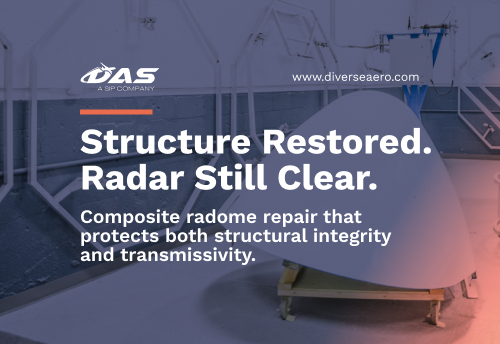
A radome repair has to satisfy two masters at once: it must restore structural integrity so the part survives flight loads and weather, and it must preserve transmissivity so the radar still sees clearly. A repair that is structurally sound but degrades the signal is not an acceptable repair.
The radome sits at the very nose of the aircraft, taking the full force of rain, hail and bird strikes — and yet it has to stay nearly transparent to the weather radar behind it.
That dual demand makes radome work unlike any other composite job.
A radome is a structural composite housing that protects the weather radar antenna while letting its signal pass through.
Because it leads the aircraft, it is one of the most exposed structures on the airframe.
And because the radar transmits and receives through it, the radome cannot be treated like an ordinary panel. Any repair changes not just its strength, but how radar energy moves through the material.
Because of its position, the radome absorbs impacts the rest of the airframe never sees.
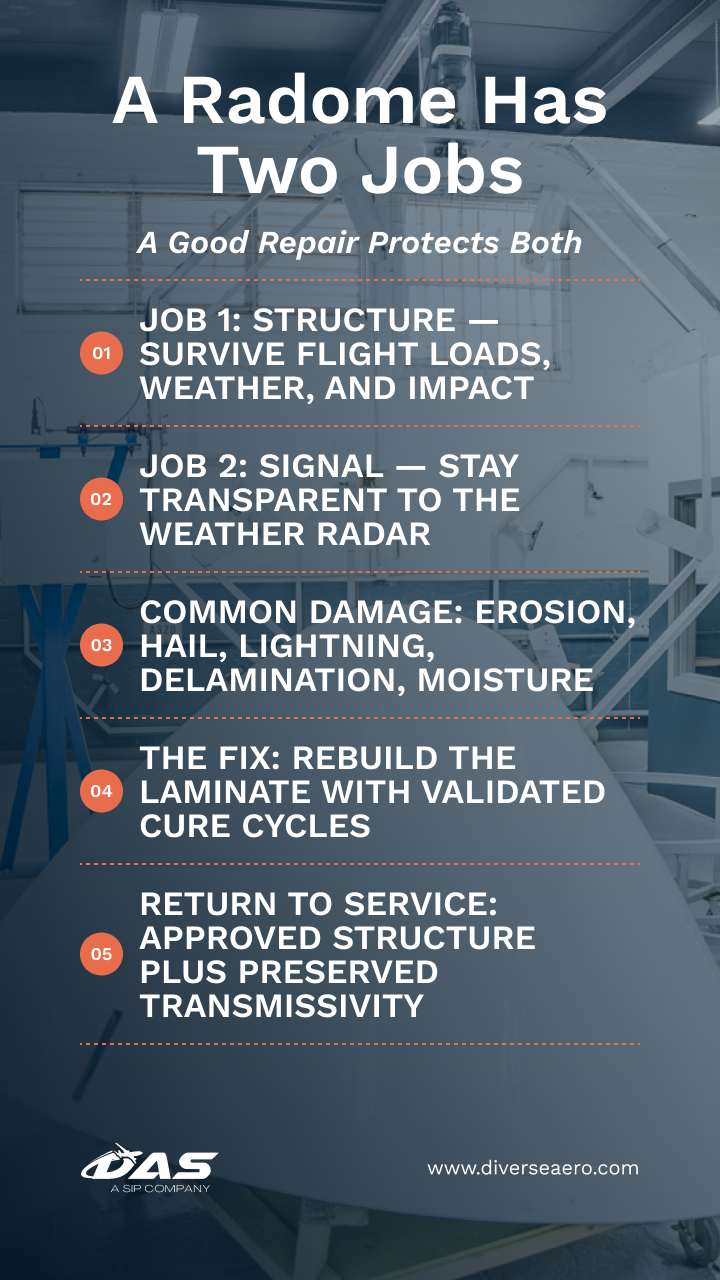
Common damage includes erosion and pitting from rain and particles, impact from hail or bird strikes, lightning strike damage, and delamination or disbond in the composite laminate.
Moisture ingress is another frequent finding, and it can quietly degrade both the structure and the radar performance over time.
Damage to the radome's erosion protection, paint or diverter strips also matters more than it might seem.
Those features are part of how the radome sheds weather and manages lightning, and their condition affects both durability and radar behaviour. It is why radome inspection looks beyond obvious cracks, to the whole system that keeps the part working.
Radome transmissivity is the measure of how efficiently radar energy passes through the radome.
It depends on the material, the wall construction and — critically — what a repair adds or removes.
Too much added material, the wrong material, trapped moisture or an uneven repair can distort or attenuate the signal, degrading the accuracy of what the crew sees on the weather radar display.
That is why a radome repair is never just about filling and sanding a damaged area.
The repair has to restore the wall in a way that keeps the radar transparent, using appropriate materials and controlled processes. Both properties are treated as pass/fail conditions.
A sound composite radome repair rebuilds the laminate to restore load-carrying capability while respecting the wall's electromagnetic design.
Delamination and disbond are removed and the structure rebuilt with correct materials and layup. Erosion protection and surface finishes are re-established so the radome sheds weather as designed.
Every step is chosen to protect both strength and transmissivity.
Controlled processing is essential. DAS performs bonded and bolted composite repairs using validated cure cycles, in dedicated structural bays with environmental controls for temperature and humidity.
That control keeps moisture and contamination out of the laminate during curing — which matters doubly on radomes, where trapped moisture harms both the structure and the radar signal.
Returning a radome to service means confirming it satisfies both of its jobs.
The structural repair must meet the approved data, and the radome's ability to pass radar energy must be preserved to the required standard.
Because the part combines a demanding structural role with a performance role, the return-to-service decision rests on the full engineering picture — not on appearance alone.
When damage runs beyond what the manual covers, an engineered repair path may be required.
With in-house engineering and DER-based repair support, DAS can substantiate a radome repair beyond standard limits when the structure allows — and confirm plainly when replacement is the sounder choice.
Radomes are within the DAS composite scope at its Miami facility, alongside panels, fairings, nacelle components, control surfaces, winglets and ducts.
DAS holds FAA (8ZTR320C), EASA (145.6887) and UK CAA (145.50252) approvals with Airframe ratings Class I through IV, and pairs its structural bays with in-house engineering — so the structural and engineering sides of a radome repair are handled together.
To begin, send the damage description or report, drawings and photos, part or component identification, and the aircraft application.
DAS reviews the condition and confirms the repair path, weighing both structural integrity and radar performance before work starts.
An aircraft radome repair rebuilds the damaged composite structure while preserving the radome's ability to pass radar energy. It addresses delamination, disbond, erosion and moisture, using controlled materials and cure so both structural integrity and radar performance are restored.
Radome damage such as delamination, moisture ingress or improper repair can reduce radome transmissivity, distorting or weakening the radar signal. That degrades weather radar performance and the accuracy of what the crew sees, which is why repairs must protect the signal, not just the structure.
Radome transmissivity is how efficiently radar energy passes through the radome wall. It matters because too much added material, the wrong material or trapped moisture can attenuate the signal — so a composite radome repair must restore structure while keeping the wall radar-transparent.
Often, yes. Radome delamination can be repaired when engineering shows the structure and transmissivity can both be restored. With in-house engineering and DER support, DAS can substantiate a repair beyond standard limits, or confirm when replacement is the better path.
Radome return to service requires meeting the approved structural repair data and preserving radar transmissivity to the required standard. Because the radome serves both a structural and a performance role, the decision rests on the full engineering picture rather than appearance.