A DER repair is a structural repair approved through a Designated Engineering Representative — an FAA-authorized engineer — when the damage falls outside the limits published by the manufacturer. It lets you return the aircraft to service with fully approved data, instead of defaulting to an expensive replacement.
Sooner or later, every operator meets a damage the Structural Repair Manual simply does not cover. The dent is a little too deep, the crack a little too long, or the location falls outside the SRM's approved limits.
That is the moment a DER repair enters the conversation.
DER stands for Designated Engineering Representative: an engineer authorized by the FAA to approve engineering data on the agency's behalf.
When a repair falls outside the limits published by the manufacturer, someone with the proper authority has to review the engineering and formally approve the fix.
A DER repair is exactly that — a structural repair supported and approved through this engineering channel, rather than by the standard manual alone.
The approval is documented, traceable and specific to your condition. It is not an informal workaround.
It is a substantiated repair, backed by analysis and, where required, an FAA Form 8110-3 that records the approved data. For the operator, that means the repair carries the paperwork it needs to stand up to any subsequent audit or inspection.
For most in-service damage, the Structural Repair Manual is the right and fastest answer.
The OEM has already engineered and approved a family of repairs. When your damage fits inside those limits, you follow the manual and move on.
There is no need to involve a DER when the SRM already covers the case.
The SRM stops being enough when the damage exceeds its dimensional limits, sits in a location the manual does not address, overlaps with a previous repair, or combines several conditions the manual never anticipated.
At that point, you have three options: replace the part, seek OEM engineering support, or pursue an approved repair through a DER.
The third path is often the fastest and most economical — when replacement parts are costly, long lead-time, or simply unnecessary for the actual damage.
A DER repair is worth considering whenever the structure is fundamentally sound but the specific damage falls outside published limits.
Typical triggers include corrosion or impact damage that exceeds SRM cleanup allowances, cracks near fasteners or edges the manual does not cover, damage on composite panels and bonded assemblies, and situations where a new part carries a lead time the schedule cannot absorb.
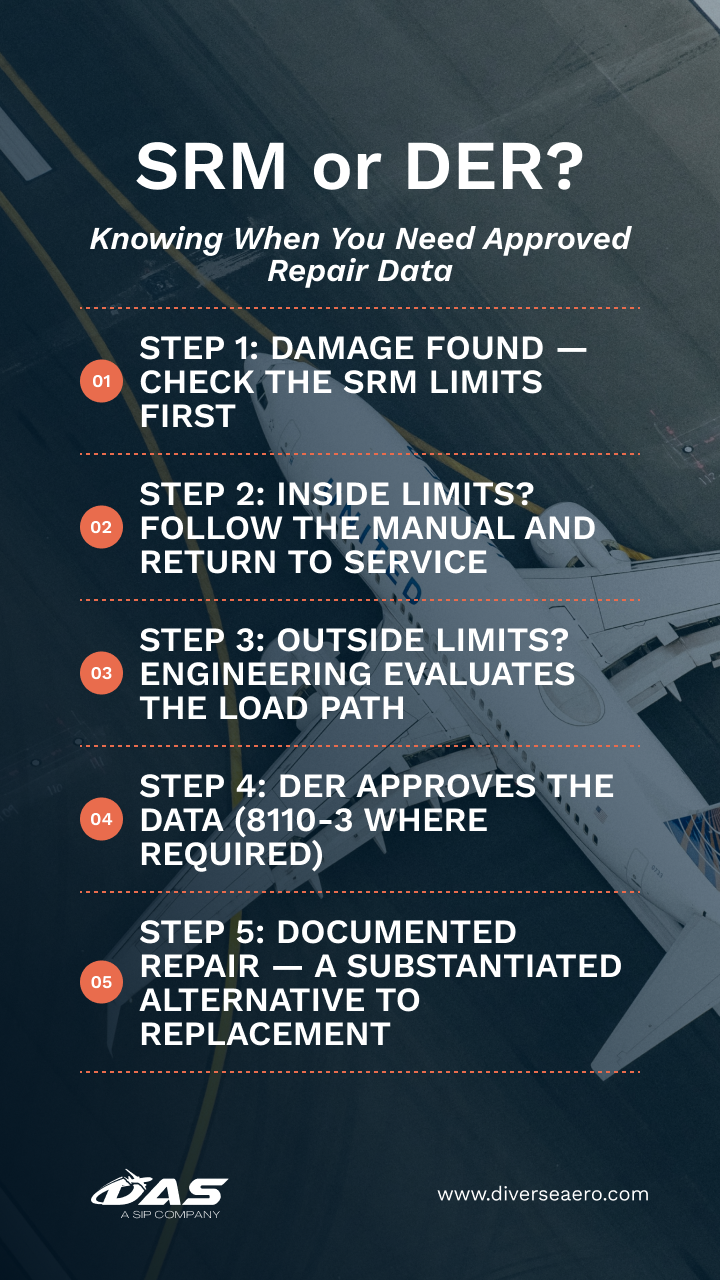
An approved repair beyond the SRM is built on substantiation.
The engineer evaluates the load path, the material, the environment the part lives in, and how the proposed repair restores original strength and durability.
Static strength, fatigue and — for the right structures — damage tolerance are all considered, so the repair behaves like the structure it replaces over the life of the aircraft.
The output is approved repair data: drawings, materials, processes and inspection requirements that the shop follows exactly.
Because the data is formally approved, the repair is not a judgment call on the hangar floor. It is a controlled, documented procedure — and that discipline is what makes a DER repair a legitimate alternative to replacement rather than a shortcut.
Replacement is not always the conservative choice. Sometimes it is simply the default choice, because no one engineered an alternative.
A well-substantiated DER repair can restore full airworthiness while keeping a serviceable structure in service, avoiding the cost and lead time of a new component.
For structures like panels, fairings, control surfaces and nacelle components, an engineered repair frequently returns the part to its original capability.
The decision always rests on the engineering. If analysis shows the structure can be restored to its required strength and durability within an approved repair, replacement may be unnecessary. If it cannot, the same engineering honesty tells you to replace.
The value of the DER path is that the choice is made on substantiated data — not on the absence of an option.
DAS is an FAA Repair Station (8ZTR320C), with EASA (145.6887) and UK CAA (145.50252) approvals, holding Airframe ratings Class I through IV.
Based in Miami, the shop combines in-house engineering with DER-based repair support — so evaluation, engineering and the physical repair happen under one roof rather than across disconnected vendors.
To open a review, send the damage description or report, drawings and photos, part or component identification, and the aircraft application.
DAS reviews the condition and confirms the repair path — whether the damage stays within the SRM or needs an engineered, DER-supported repair — so you get a clear answer before committing to replacement.
A DER repair is a structural repair approved through a Designated Engineering Representative — an FAA-authorized engineer — when the damage falls outside standard OEM limits. It uses approved repair data, so the fix is fully substantiated and documented for return to service.
When the damage exceeds the Structural Repair Manual's size, depth, location or proximity limits, or overlaps a prior repair, the SRM no longer provides approved data. A designated engineering representative can evaluate the condition and approve an engineered repair specific to it.
FAA Form 8110-3 is the document a DER uses to record approved engineering data for a repair. It matters because it gives your repair traceable, formal approval that stands up to audits and supports a clean return to service.
Yes. When engineering analysis shows the structure can be restored to its required strength and durability, a DER repair approval is a legitimate alternative to replacement — often saving the cost and lead time of a new component while keeping full airworthiness.
Send DAS the damage description or report, drawings and photos, part or component identification, and the aircraft application. DAS reviews it with in-house engineering and DER support, then confirms whether the repair stays within the SRM or needs approved repair data beyond it.