Honeycomb sandwich panels hide their problems well. A panel can look perfectly serviceable while water sits in the core, or the skin has quietly let go of the honeycomb beneath it.
They are everywhere on a modern airframe — light, stiff and efficient. Honeycomb structure repair is about finding what the surface conceals, and restoring the panel's strength before the damage spreads.
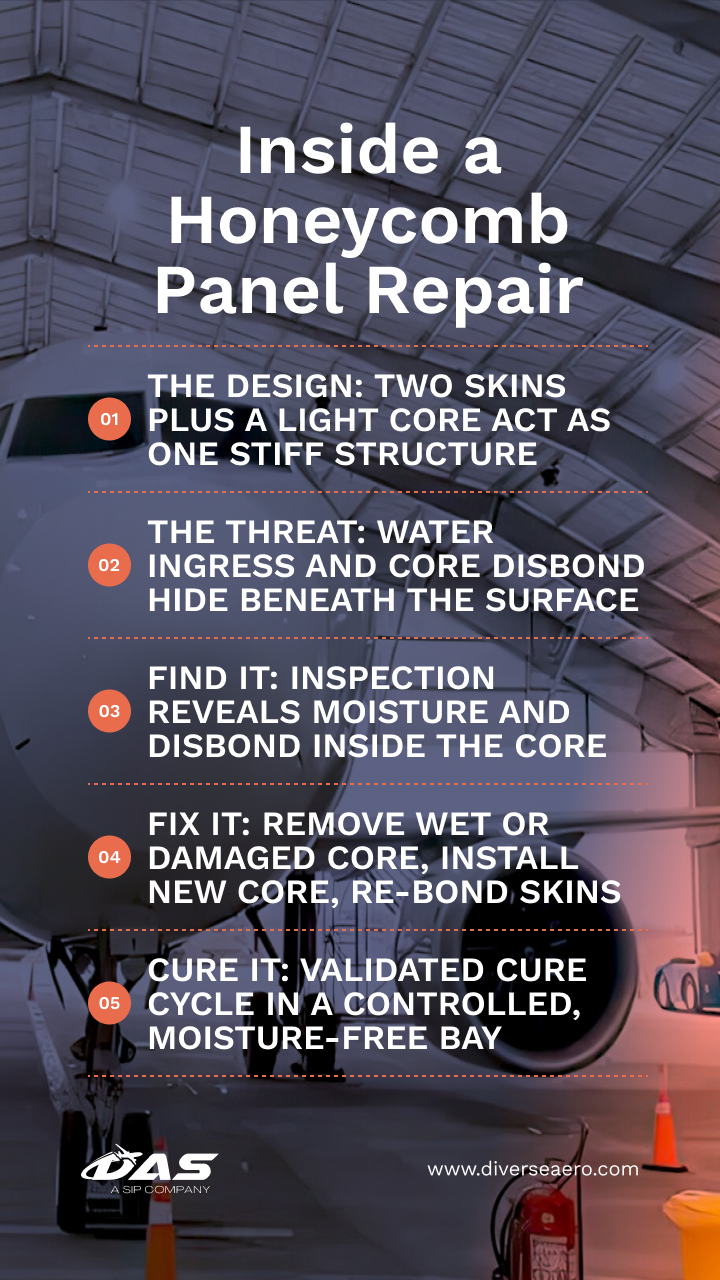
A sandwich panel works like an I-beam: two thin, stiff skins carry the bending loads, while a lightweight honeycomb core holds them apart and carries shear.
The magic is in the teamwork. The skins and core act as one only as long as the bond between them is intact.
That is what makes the design so efficient — and also what makes it vulnerable in a specific way.
When the bond between skin and core fails, or the core itself is crushed or waterlogged, the panel stops behaving like a single unit.
The skins can no longer rely on the core, stiffness and strength drop, and the panel is no longer doing the job it was designed for. Sandwich panel repair exists to re-establish that skin-core teamwork.
Water ingress is one of the most common and most underestimated problems in bonded panels.
Once moisture finds its way past a damaged skin, seal or edge, it collects in the honeycomb cells where it is hard to see and slow to leave.
Over time it degrades the bond, corrodes metallic cores and adds weight — and through freeze-thaw cycles at altitude it can drive further disbond and skin cracking.
Because trapped water is largely invisible from outside, moisture is a leading reason honeycomb panels need attention. A panel that still looks fine can be carrying water that is steadily undermining it.
That is why composite panel inspection uses methods that reveal what is inside the core — and why any repair has to fully remove wet material rather than seal it in.
Core disbond is the loss of the bond between the skin and the honeycomb core.
It can start from impact, from moisture, or from a manufacturing or prior-repair weakness, and under service loads it tends to grow.
Once the skin is not tied to the core, load can no longer transfer between them, and the affected area becomes a soft spot in an otherwise stiff panel.
Core damage also includes crushing and fracture of the honeycomb itself — from impact, over-torqued fasteners or handling.
Whatever the cause, the compromised core cannot carry shear. The repair must remove the damaged core, install sound replacement core, and re-bond the skins so the sandwich acts as one structure again.
Restoring strength means restoring the whole load path through the panel, not just the skin surface.
A sound bonded panel repair rebuilds the sandwich so skins and core share load exactly as designed.
That means fully removing wet, disbonded or crushed material, drying the structure as required, fitting and bonding replacement core, and restoring the skin plies with correct materials and orientation.
Only then is the panel returned to its intended stiffness and strength.
Every step depends on process control. Any moisture or contamination left in the panel will compromise the new bond, so the environment and the cure matter as much as the layup.
A repair that skips the drying or rushes the bond can look complete and still leave a weak panel. Honeycomb repair is a discipline, not a quick fix.
Bonded panel repairs reach their designed strength only when the adhesive cures under controlled conditions, free of the moisture and contamination that undermine a bond.
DAS performs bonded and bolted repairs using validated cure cycles in dedicated structural bays, with environmental controls for temperature and humidity — exactly the conditions honeycomb work demands, because these panels are so sensitive to trapped moisture.
That controlled environment is what turns a good repair plan into a durable result.
It keeps water out of the core during the repair, lets the adhesive develop the properties the engineering relies on, and gives consistent, repeatable outcomes.
Honeycomb and sandwich panels fall squarely within the DAS composite scope at its Miami facility, alongside fairings, nacelle components, control surfaces, radomes, winglets and ducts.
DAS holds FAA (8ZTR320C), EASA (145.6887) and UK CAA (145.50252) approvals with Airframe ratings Class I through IV, and combines dedicated structural bays with in-house engineering and DER-based repair support.
When core damage or disbond runs beyond the SRM, that engineering capability lets DAS pursue a substantiated, engineered repair rather than defaulting to replacement — or confirm honestly when replacement is the sounder call.
To start, send the damage description or report, drawings and photos, part or component identification, and the aircraft application. DAS then confirms the repair path.
Honeycomb structure repair restores a sandwich panel when the core is damaged, disbonded or waterlogged. It is needed when the skin-to-core bond or the core itself fails, because the panel then loses the stiffness and strength its sandwich design provides.
Water ingress lets moisture collect inside the honeycomb cells, where it degrades the bond, corrodes metallic core, adds weight and drives further disbond through freeze-thaw at altitude. Because it is hidden, water ingress in composite panels often requires inspection methods that reveal the core's condition.
Core disbond is separation between the skin and the honeycomb core, which stops load transferring between them. Bonded panel repair removes the disbonded and damaged material, installs sound replacement core, and re-bonds the skin so the sandwich carries load as one structure again.
Composite panel inspection looks beyond the surface, because moisture and core disbond are often invisible from outside. Methods that reveal what is inside the core are used to map water ingress and disbond before a sandwich panel repair defines how much material must be removed.
Frequently, yes. When engineering shows strength can be restored, honeycomb core damage can be repaired with replacement core and re-bonded skins. With in-house engineering and DER support, DAS can substantiate a repair beyond the SRM, or confirm when replacement is the better choice.