Few moments put an aircraft's paperwork under more scrutiny than a lease return. When an aircraft goes back to the lessor, the physical asset is inspected — and so is its history. Every structural repair carried out during the lease is expected to be traceable, substantiated, and cleanly documented. If the records are complete and well-ordered, the review moves quickly. If they are scattered, incomplete or hard to follow, the same repairs can turn into findings, questions and last-minute delays — often at the worst possible time in the transition. The good news is that "audit-ready" is not luck. It is the result of documenting each repair properly as it happens, so that nothing has to be reconstructed later.
Structural repairs matter to the value and airworthiness of the asset, so they naturally draw the closest look during a return review. The reviewer is not only asking "was the aircraft repaired?" — they are asking whether each repair was carried out against approved data, by an appropriately approved organization, and recorded in a way that can be followed from the damage to the release. In practice, the aircraft can be in excellent physical condition and still create friction at return simply because the supporting documentation for a structural repair is thin or difficult to trace. Upon return, the records are the evidence. If a repair cannot be clearly evidenced, it can be treated as an open question — even when the work itself was sound.
The specifics vary by aircraft, operator and agreement, but a strong, review-ready record for a structural repair generally lets a reviewer follow a clean thread from damage to return-to-service. In general terms, that thread includes:
The aim is simple: a reviewer should be able to pick any structural repair and follow it end to end without having to ask for missing pieces.
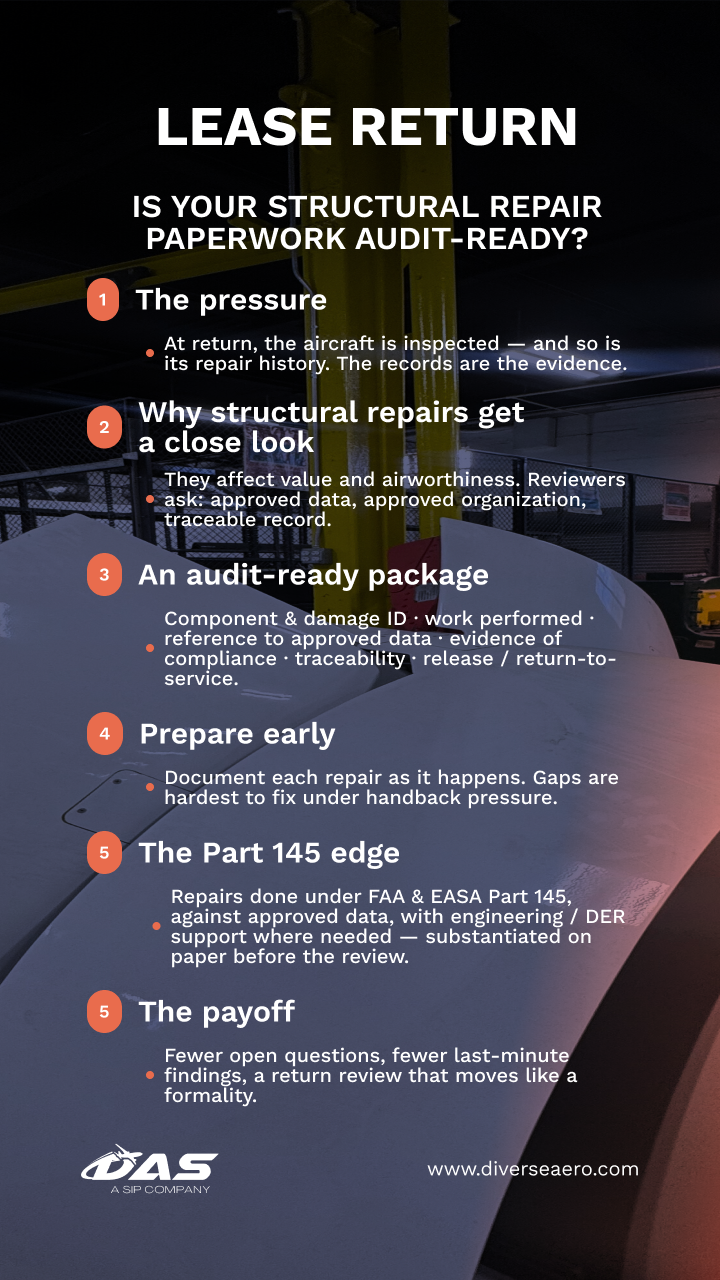
The pressure of a lease return tends to compress everything into a narrow window, and documentation gaps are the hardest thing to fix under time pressure. Reconstructing the basis for a repair — or chasing records after the fact — is far more costly and stressful than capturing it correctly the first time. Repairs are documented properly as they are performed; simply carry forward; there is nothing to rebuild. Treating audit-readiness as an ongoing habit throughout the lease, rather than a scramble at the end, is what turns the return review from a risk into a formality.
This is where the choice of repair provider quietly pays off. A capable structural provider does not just perform the repair — it hands back a clean, complete record built to stand up to later review. When repairs are done under FAA & EASA Part 145 approvals, against approved data, with clear traceability and proper release, each repair arrives at the return review already substantiated. Where standard data does not apply, in-house engineering support — including DER-based repair pathways — can provide the approved basis and the documentation to match, so even the harder repairs are defensible on paper. The result is fewer surprises, fewer open questions, and a return package a reviewer can move through with confidence.
At DAS (Diverse Aircraft Services), aircraft structures and composites are the specialty — backed by FAA & EASA Part 145 approvals and in-house engineering support, from Miami. That combination means the repairs we perform are documented to be audit-ready long before the aircraft is due back.
A lease return is not the moment to discover a documentation gap. Structural repairs are reviewed closely, and at that stage, the records are the proof. Document each repair completely and traceably as it happens — component, work, approved data, compliance evidence, traceability and release — and the return review becomes a formality instead of a scramble.
Preparing an aircraft for return, or do you want your structural repairs documented to stand up to review? Talk to DAS early — we'll help you keep the records audit-ready
For the foundation this rests on — how structural repairs are tracked and evidenced in a repair station — see our guide: "Structural Repair Traceability in Part 145 Repair Stations."
Audit-ready is not luck; it is the result of documenting each repair properly as it happens, so nothing has to be reconstructed later. When an aircraft goes back to the lessor, the physical asset is inspected and so is its history, and every structural repair is expected to be traceable, substantiated, and cleanly documented. Repairs are documented properly as they are performed; simply carry forward.
A strong, review-ready record lets a reviewer follow a clean thread from damage to return to service. In general terms, that thread includes component and damage identification, the work performed, reference to approved data, evidence of compliance, traceability, and the release or return-to-service record that closes the loop. The aim is that a reviewer can pick any repair and follow it end to end without asking for missing pieces.
Structural repairs matter to the value and airworthiness of the asset, so they naturally draw the closest look. The reviewer is asking whether each repair was carried out against approved data, by an appropriately approved organization, and recorded in a way that can be followed from the damage to the release. At return, the records are the evidence, and a repair that cannot be clearly evidenced can be treated as an open question even when the work was sound.
A lease return compresses everything into a narrow window, and documentation gaps are the hardest thing to fix under time pressure. Reconstructing the basis for a repair or chasing records after the fact is far more costly and stressful than capturing it correctly the first time. Treating audit-readiness as an ongoing habit throughout the lease turns the return review from a risk into a formality.
A capable structural provider does not just perform the repair; it hands back a clean, complete record built to stand up to later review. When repairs are done under FAA and EASA Part 145 approvals, against approved data, with clear traceability and proper release, each repair arrives at the review already substantiated, and in-house engineering including DER-based pathways can provide the approved basis where standard data does not apply. At DAS, aircraft structures and composites are the specialty, backed by FAA and EASA Part 145 approvals and in-house engineering support, from Miami.