
Aircraft structural repair is the work of returning a damaged part of the airframe's load-carrying structure to at least its original or properly altered condition, including its structural strength, under data that authorizes the method, and closing it with a record that stays with the aircraft. Every structural repair answers two separate questions. Does the damaged part carry load? And could a poorly done repair affect airworthiness? The second question decides whether the repair is major or minor, and that answer shapes almost everything that follows.
Most of the confusion around structural repair comes from reading "major" as a measure of size. It is not. A small repair on a spar can be major, while a larger patch on a fairing can be minor. The classification follows the effect a repair could have, and it sets the data the work needs, who may approve it and what paperwork the aircraft carries afterward. Knowing that before the work starts is the difference between a repair you planned and a repair that surprises you at lease return.
Aircraft structure is every part of the airframe that carries flight loads, ground loads or cabin pressure, or holds the geometry the aircraft was certified with. Primary structure carries the main loads: spars, ribs, frames, stringers, longerons, pressure bulkheads and the stressed skins of the wing and fuselage. Secondary structure, such as fairings and access panels, carries mostly local loads.
The distinction matters because structural damage is judged by where it sits, not by how it looks. A dent in a fairing and a dent of the same depth in a fuselage skin next to a frame are two different findings with two different outcomes. Flight control surfaces, nacelle structure, radomes and composite panels belong to the same domain, and the causes and types of aircraft structural damage that affect them have their own guide.
Every structural repair begins by establishing how far the damage actually goes. The visible mark is rarely the edge: an impact can leave a shallow dent outside and cracking or delamination underneath. Inspection, often with nondestructive testing, sets the boundary, and that boundary is what gets compared against published limits. A repair scheme drawn before the boundary is known is drawn against the wrong damage.
That is where a dent, a buckle or a gouge gets its first answer, measured against published limits. The methods that find the real extent, from visual inspection to ultrasonic and eddy current testing, are compared in structural inspection methods.
Under US rules, a major repair is defined as one that, if improperly done, might appreciably affect weight, balance, structural strength, performance, powerplant operation, flight characteristics or other qualities affecting airworthiness, or one that is not done according to accepted practices or cannot be done by elementary operations. A minor repair is simply any repair that is not major.
The definition never mentions size. It asks what would happen if the repair went wrong. That is why the regulation's list of airframe major repairs, in Appendix A to 14 CFR Part 43, reads like an inventory of primary structure: box beams, spars, spar flanges, wing stringers, main ribs, fuselage longerons, bulkhead members and parts of the control system. Where size does appear, it works as a trigger. Repairing damaged areas of metal stressed covering that exceed six inches in any direction is a major repair, and so is any repair that involves substituting material.
European guidance on classifying repairs starts from the same principle and adds a useful admission. It accepts a qualitative judgment for the initial classification, because the full certification data is not always available to whoever classifies the repair, and it expects that a later review of the repair design may reclassify it. A repair that starts as minor can become major once the engineering is done, and a schedule built around the first label is how downtime grows.
The table summarizes what each class sets in motion. The approval routes behind the right-hand column, including how FAA and EASA pathways differ, have their own article on major structural repair approval.
A structural repair is performed under one of two kinds of data. The first is data the manufacturer already published for that damage, usually in the structural repair manual. The second is engineering data approved for that specific repair, when the damage falls outside what the manual covers. The kind of data and the class of the repair are two different questions.
FAA guidance on obtaining data approval states it plainly: major repairs must be performed using approved data, while minor repairs may use data acceptable to the FAA. A repair that follows the manual can still be major. The manual supplies the approved data; it does not change what the repair could affect if it went wrong.
The opposite mistake is just as common. Damage that falls outside the manual is not unrepairable. It moves the decision to engineering, which is a different route with a different document. What happens on that route, who approves the data and on what authority, is explained in our article on damage that exceeds the SRM.
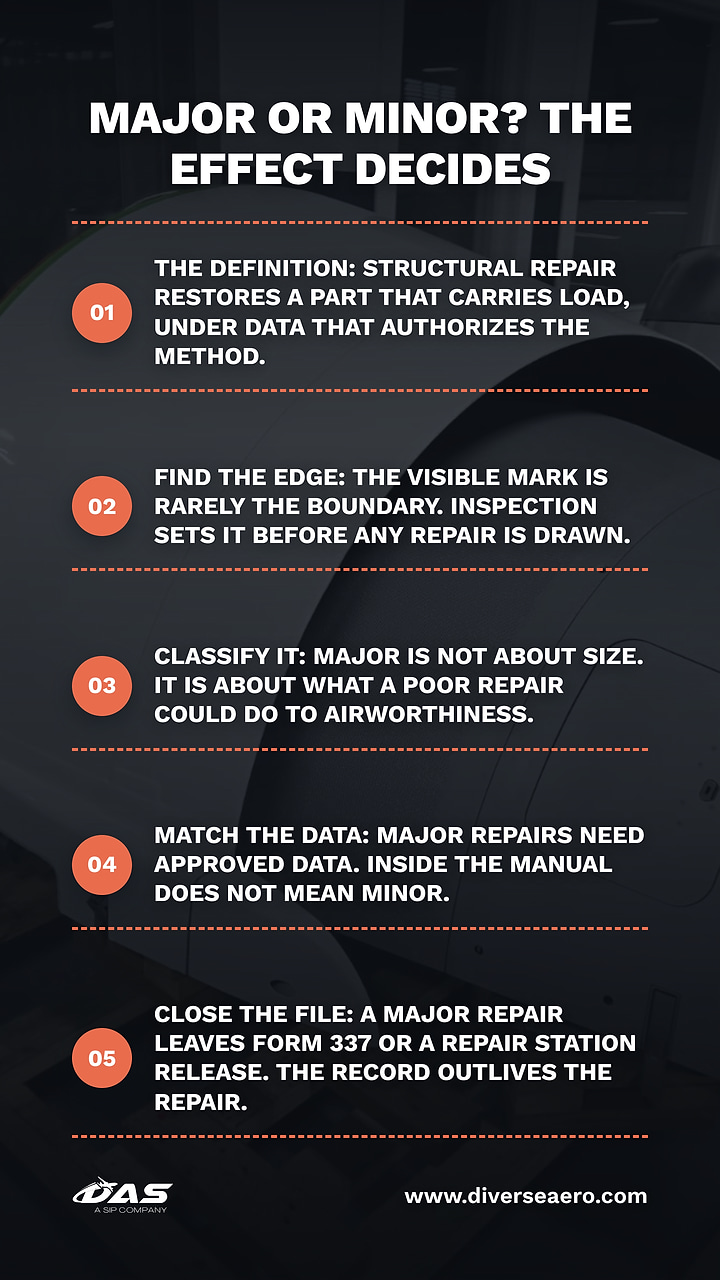
Every repair ends in a maintenance record entry: a description of the work or a reference to the data used, the completion date, and the signature and certificate of whoever approved the return to service. A major repair adds a second document. The default is FAA Form 337, executed at least in duplicate, with a signed copy to the aircraft owner and a copy forwarded to the FAA within 48 hours of return to service.
There is one exception that matters to anyone sending structure to a repair station. When a certificated repair station performs a major repair under a manual or specifications acceptable to the FAA, the rule lets it use the work order in place of Form 337, and give the owner a signed maintenance release that identifies the aircraft and the repaired area. Air carriers add their own layer: each major repair on an aircraft they operate gets a report kept available for FAA review.
These documents outlive the repair. A buyer, a lessor or an authority reads them years later, and a major repair without its form is a gap the next owner inherits. The chain of evidence behind them is the subject of structural repair traceability, and how it is read when an aircraft goes back is covered in lease return documentation.
The location of a repair changes the logistics, not the classification. A structural repair performed in the hangar and one performed on the ramp during an aircraft on ground event are judged by the same test and recorded the same way. What changes is what the site allows, from controlled cure conditions to access and fixtures.
The sequence does not change either: assess the damage and its boundary, classify the repair, identify or obtain the data, perform and inspect the work, and approve the return to service with the records complete. Each step is described in the walkthrough of how structural repairs are performed.
A repair recognized as major at the start gets its data, its approval and its form planned in. The same repair discovered to be major halfway through adds them as delays.
No. A repair restores a damaged part to its original or properly altered condition. An alteration changes the design or configuration of the aircraft. Both are classified as major or minor by the same test, which is whether the work might appreciably affect airworthiness, and both major categories require approved data and a major repair or alteration record.
Yes. A repair is first classified on the information available, and the class can change once the repair design is reviewed. It can also change on the shop floor, when the damage extends further than the first inspection showed or the repair calls for a different material.
No. The manual is a source of approved data, not a classification. A repair to primary structure can be major and still follow the manual exactly. US rules recognize this case directly: a repair station performing a major repair under an acceptable manual may document it with a work order and maintenance release instead of FAA Form 337.
The person performing and approving the work makes the call, applying the regulatory definition and the list in Appendix A to 14 CFR Part 43. When a field approval is requested, an FAA inspector confirms the classification. Where the answer is unclear, a conservative practice is to plan the repair as major until engineering confirms otherwise.
Not sure which class your damage falls into? Send us the damage report and we will tell you how it classifies, and why.