Across the industry, mature narrow-body aircraft are staying in service longer than earlier fleet plans assumed. Robust demand, new-aircraft delivery delays, and the strong residual value of proven types mean that airframes many operators once expected to retire are still flying revenue routes. That is good news for asset economics — but it puts a spotlight on something every engineering and maintenance team already knows: structures do not stop accumulating cycles just because the market wants the aircraft to keep working. For operators of mature fleets, the nacelle and its surrounding structure deserve particular attention.
Aircraft structures are engineered to a long but finite service life. As an airframe accumulates flight cycles and calendar time, the physics that designers accounted for from day one simply keep advancing. None of this is cause for alarm — it is expected, well understood, and managed every day across the fleet — but it does mean the emphasis shifts, over time, from routine care toward more deliberate structural attention. The main mechanisms are familiar to any structures engineer:
The nacelle group — inlet cowl, fan cowls and thrust reverser — lives in one of the most demanding environments on the aircraft. It sees acoustic and vibratory loading, large thermal swings, high-energy airflow and, on the thrust reverser, repeated actuation. It also combines metallic structure, honeycomb-cored panels and composite skins, sometimes within a single assembly. That mix of materials and duty is exactly where fatigue, corrosion and disbonding tend to show up first on a mature airframe. Inlet cowls, acoustic panels, thrust reverser components and fan cowl structure are all worth building into a proactive inspection mindset rather than waiting for a finding to force the issue.

Keeping an aging fleet serviceable is less about a single dramatic action and more about disciplined, proactive habits:
When a finding is characterized, most damage can be returned to a serviceable condition through established repair data. But mature structures sometimes present situations that published, standard repair data does not fully cover — an out-of-limits area, overlapping repairs, or damage in a location the manuals did not anticipate. That is where engineering support and DER repairs matter. An approved, engineering-substantiated repair can restore a component to a serviceable, airworthy condition when off-the-shelf data falls short — often keeping a valuable structure in service rather than forcing an early, costly replacement. This is core to what DAS does: aircraft structures and composites, backed by engineering and DER capability, under FAA and EASA Part 145 approvals.
If your fleet is flying longer than originally planned, the nacelle and surrounding structure are worth a proactive conversation. DAS can help assess condition, map damage and define the right repair path — standard or DER — to keep components serviceable. Reach out to start.
For a deeper look at the components discussed here, see our June pillar article, “Large Aircraft Structural Component Repair: Inlet Cowls, Thrust Reversers, and Flight Controls,” which walks through how these large structures are repaired in practice.
Mature narrow-body aircraft are staying in service longer than earlier fleet plans assumed, and structures do not stop accumulating cycles just because the market wants the aircraft to keep working. The nacelle group lives in one of the most demanding environments on the aircraft, seeing acoustic and vibratory loading, large thermal swings, high-energy airflow and, on the thrust reverser, repeated actuation. That mix of duty and materials is where fatigue tends to show up first on a mature airframe.
The main mechanisms are familiar to any structures engineer: fatigue from repeated pressurization, thermal and aerodynamic loading; corrosion, which can hide beneath finishes and interacts with fatigue rather than acting alone; delamination and disbonding in composite and bonded assemblies; and load-path changes from damage, prior repairs and wear. None of this is cause for alarm, but the emphasis shifts over time from routine care toward more deliberate structural attention.
Keeping an aging fleet serviceable is less about a single dramatic action and more about disciplined, proactive habits. Inspect proactively rather than reactively, map damage accurately by location, size, depth, material, and relationship to load paths, use NDT where it earns its place to reveal sub-surface corrosion and internal disbonds, and account for prior repairs since on a mature component they are part of the current structure. Small, well-characterized findings are far easier to manage than those discovered late.
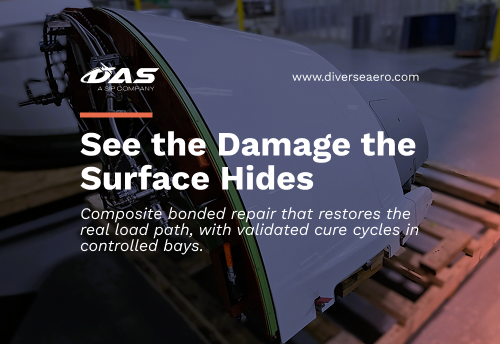
In composite and bonded assemblies, plies can separate, or a bondline can lose adhesion after impact, moisture ingress or long service, and the external surface can look intact while the internal load path is compromised. This is why non-destructive testing matters: it helps reveal what a visual check cannot, including internal disbonds and the true extent of delamination behind an intact-looking skin.
Once a finding is characterized, most damage can be returned to a serviceable condition through established repair data. But mature structures sometimes present situations standard data does not fully cover, such as an out-of-limits area, overlapping repairs, or damage in a location the manuals did not anticipate. That is where engineering support and DER repairs matter, restoring a component to a serviceable, airworthy condition and often keeping a valuable structure in service rather than forcing an early replacement, which is core to what DAS does under FAA and EASA Part 145 approvals.