Aircraft composite repair is the work of restoring a damagedlaminate's ability to carry load, under data that authorizes the method used.Two families exist. A bonded repair transfers load through an adhesive joint. Abolted repair transfers it through mechanical fasteners. Which one applies isnot a shop preference — it is a consequence of four conditions that arrive withthe damage itself: depth, load path, access and substrate.
Operators are routinely quoted two different repairs forwhat looks like the same dent, and read the gap as a difference between shops.It is usually a difference in the damage. The four conditions below are what astructures engineer reads before naming a method, and most of them are alreadysitting in the damage report.
Four conditions decide. How deep the damage runs into thelaminate. Whether the area sits on a primary load path. How much access thestructure allows, on one side or both. And what the substrate is — solidlaminate or honeycomb sandwich. Shallow, distributed damage with good accesspoints toward a bonded repair. Deep damage on a highly loaded joint pointstoward fasteners.
Depth is thefirst filter. Surface scuffs, resin cracks and shallow ply loss can often berestored by scarfing back the damaged plies and laminating new ones in. Oncethe damage runs through a significant share of the laminate thickness, orthrough the core of a sandwich panel, the joint has to carry more load than anadhesive bond line can reasonably be qualified for on that part.
Load path is thesecond, and it is the one operators underestimate. A 50 mm delamination in afairing and a 50 mm delamination in a wing-to-body attachment area are the samemeasurement and two different decisions. What matters is whether the areacarries primary load, and what happens to that load if the repair degrades.
Access is thecondition nobody puts in the report and everybody discovers later. A bondedrepair needs a controlled surface on one side and, for a sandwich panel, oftenneeds the core restored before the skin goes back. If the back face cannot bereached, the repair scheme changes — sometimes to a bolted doubler that can beinstalled and later inspected from outside.
Substrate closesit. Solid laminate, honeycomb sandwich and hybrid metal-composite joints behavedifferently under both adhesive and fastener load. A honeycomb panel withmoisture trapped in the core is a different repair from a dry one, no matterhow similar the surface looks — and the failure modes behind that, delamination and disbond(https://www.diverseaero.com/post/aircraft-composite-repair-delamination-disbond),are what the inspection has to separate.
The table below is the short version of a longer decision, and our composite repair decision guide covers the wider picture it sits inside.
A bonded joint has almost no tolerance for a bad process, and the reason is uncomfortable: the defect you most need to find is the one you are least likely to see. The FAA's guidance on composite aircraft structure is blunt about it — certain processing defects cannot be reliably detected at completion of the repair, and it names weak bonds as the example.
That single sentence explains most of what a structures shop does differently. If the bond cannot be verified after the fact, the quality has to be built in before and during: surface preparation to a written procedure, adhesive kept inside its handling limits, a cure cycle that actually delivered the temperature and pressure it recorded, and in-process checks at each step. The same guidance describes that process control approach as the most reliable means of ensuring the quality of adhesive bonds.
There is a practical consequence for you. When a shop quotes a bonded repair, the cure records and the process specification are not paperwork attached to the job. They are the evidence that the repair is what it claims to be.
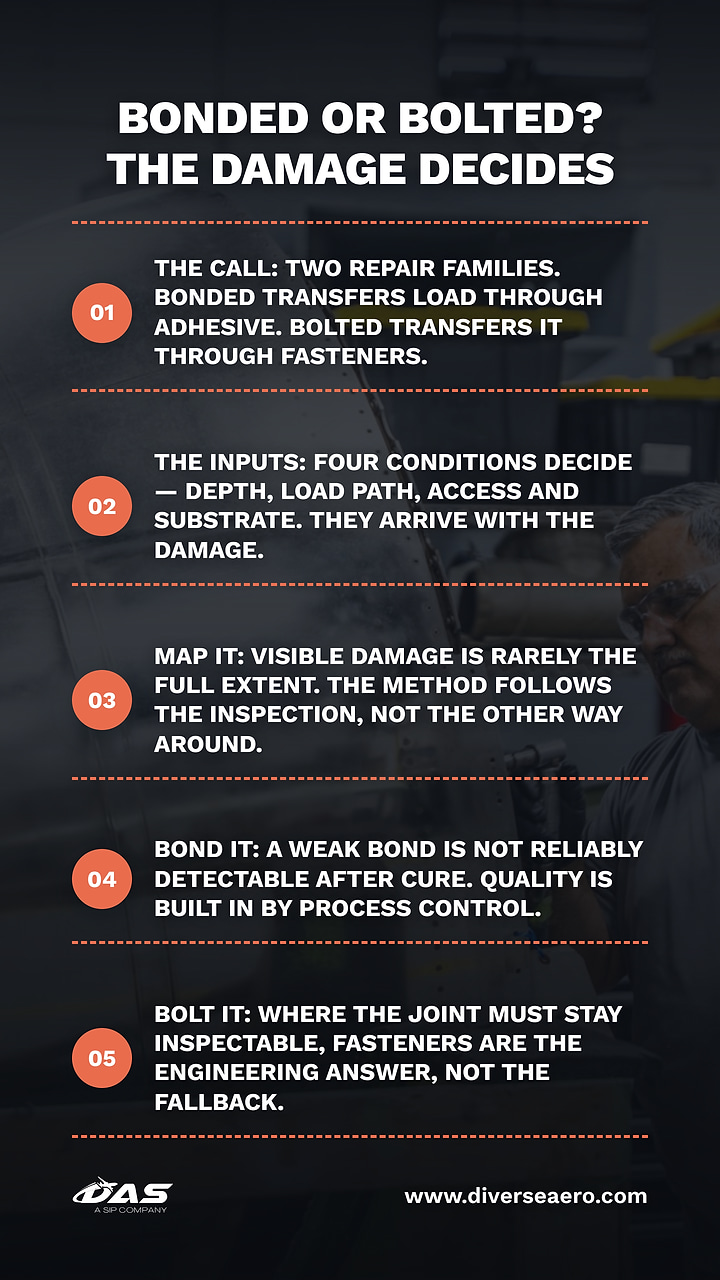
A bolted repair is often read as the lesser option. It is not. It is the option that keeps a load path inspectable.
Where damage sits on a joint carrying primary load, where the part will be re-inspected on a known interval, or where the operational window does not allow a controlled cure, fasteners transfer load through a mechanism that can be checked again in two years. That is an engineering advantage, not a fallback. It also brings its own discipline: hole quality, edge distance, fastener compatibility with the laminate, and sealing against moisture ingress.
Mapping the damage properly is what makes either choicedefensible. Visible surface marks rarely describe the full extent of a compositedefect, which is why the method conversation should follow the inspectionrather than run ahead of it. How that extent gets established is covered in ourguide to structural inspection methods.
Both routes end in a document, and the document outlives the repair.
Classification matters here. Under US rules, a repair involving the substitution of material is an airframe major repair, as is the repair of damaged areas in stressed covering exceeding six inches in any direction. A repair that looked routine on the shop floor can be a major repair on paper, and it will be read as one when the aircraft goes back at the end of a lease.
So the question to ask a structures shop is not only which method it proposes. It is what the finished record will contain: the repair scheme and the data it was approved under, the materials and their batch traceability, the cure or installation record, and the post-repair inspection result.
A method quoted without this information is a guess wearing a number:
· Photographs with a scale reference, from morethan one angle
· Damage length, width and depth, plus the dentprofile if there is one
· Location on the part, and distance to thenearest fastener row, joint or stiffener
· Whether the substrate is solid laminate or sandwich, and the moisture finding if known
· Any previous repair in the area
· The inspection results already in hand
Damage that turns out to sit inside published limits is often a straight forward repair. Damage that falls outside them is not the end of the road — it moves the decision to engineering, which is a different route with a different document, not a verdict that the part is finished.
Working a compositedamage now? Send us the damage report and we will tell you which route it points to, and why.