A nacelle enters the repair conversation through its structural condition, not its part number. Thrust reverser repair is the restoration of a reverser's load-carrying and aerodynamic structure, its composite panels, metallic frames, blocker doors, cascades and attachment areas, under approved data, so the unit returns to service as a repaired component instead of a replaced one. Whether that is possible depends on what is damaged, what the data covers and what the file will show afterward.
An MRO engineer or a buyer facing a reverser finding is usually choosing between two purchase orders: a repair, or a replacement unit. The mistake is to make that choice on the part number or the first quote. The choice follows from four things that can be known before the component ships: what is damaged and how deep, which approved data applies, whether the route is a manual scheme or an engineered repair, and which records come back with the unit. Our position is that replacement should be the conclusion of an evaluation, not the default before one.
The structure of the reverser and how it ties into the nacelle. Depending on the aircraft and the system design, a reverser may include composite panels, metallic structures, blocker doors, cascade assemblies, translating sleeves, hinges, fittings and seals, along with actuation interfaces.
A repair has to consider more than the damaged area. As our overview of large aircraft structural component repair explains, the reverser interfaces with the nacelle, the engine, the actuation system and the operating clearances, and all of them can constrain the repair. That overview also covers inlet cowls and flight controls. This article goes deeper on the reverser only, and on its structure. Actuation and control hardware is a separate discipline and is not covered here.
Four conditions that come with the damage: its depth, whether it sits on a primary load path, the access the structure allows, and the substrate. They are the same four that separate a bonded from a bolted composite repair, and our guide to bonded and bolted composite repair works through them. Applied to a reverser's panels, the practical consequence is that two dents of the same size can lead to different repairs.
The surface cannot settle any of this. A visual pass can miss internal conditions, so the extent of the damage has to be established by an approved inspection method and mapped before the path is named, as our guide to structural inspection methods explains. On a reverser there is one more variable: teardown can reveal additional findings, and the plan has to be able to absorb them.
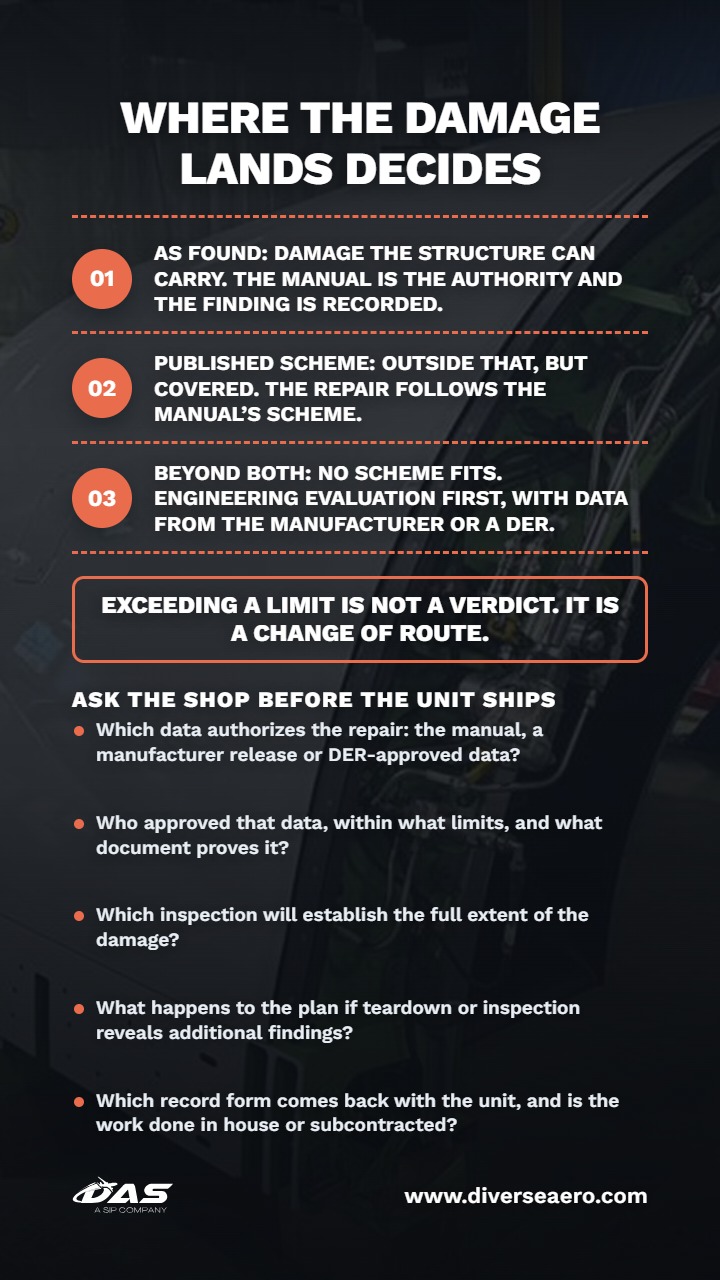
They sort the damage into three zones, and which zone the measured damage lands in decides who has to authorize the repair. Our guide to measuring damage against SRM limits describes them: damage the structure can carry as found, damage outside that but covered by a published repair scheme, and damage beyond both, with no published scheme that fits.
In the first zone, the manual itself is the authority and the finding is recorded. In the second, the repair follows the manual's scheme, applied by an appropriately rated repair station. In the third, an engineering evaluation comes before any repair is designed, and the data comes from the manufacturer or from delegated engineering. The measurement therefore matters before anything else: extent, shape, position relative to fasteners and load-carrying elements, and any associated condition around the damage. The same data comes first for a reverser as for any structure: component type, aircraft type, damage location, photographs with a scale reference, dimensions and the manual reference.
The method decides which evidence comes back. A bonded repair cannot be fully checked after cure, so its proof is in the cure records and the process specification. A bolted repair can be re-inspected later, so its proof is in the fastener and hole records. On a honeycomb panel with trapped water, the repair also has to remove the wet material rather than seal it in, and our guide to honeycomb structure repair explains why. When you compare quotes for a reverser panel, compare these records as well as the price.
The one the damage allows. Under 14 CFR 43.13, maintenance has to follow the current manufacturer's maintenance manual or Instructions for Continued Airworthiness, or other methods acceptable to the FAA Administrator, and the work has to leave the structure at least equal to its original condition. In practice, that makes approved data the hinge of every reverser repair.
There are three routes. If the damage falls inside published limits and approved data applies, the repair follows the manual. If it falls outside, the manufacturer's engineering may release a repair for it, or a delegated engineer may approve independently developed engineering data. In European contexts, an approved design organization plays that role. Our guide to damage that exceeds the SRM compares the three and explains what each leaves in the records.
Beyond the manual, then, the question is who can approve data for this damage, and replacement stays a possible answer of that evaluation.
When the facts of this unit say so. The general test for large components is in our overview of large aircraft structural component repair. For a reverser, the practical question is narrower: what does the replacement path actually look like, and does it beat the repair path for this unit? Our article on repair versus replace covers the decision more broadly.
Replacement is not a single option. A manufacturer-new unit, a PMA or DER-approved structure, an exchange or a used serviceable unit each carry different documentation, compatibility and logistics. Through its repair management service, DAS supplies structural nacelle components, including thrust reversers, with OEM, PMA and DER-approved options, traceable used serviceable material, and lease and exchange programs. That matters for the decision because the same company can speak to both sides of it, the repair path and the replacement path, in one conversation.
The invoice alone should not settle it. Repairability, inspection findings, approved data, replacement availability, logistics, documentation and future supportability all belong in the comparison.
It means the manufacturer's published repair data stops there, not that no repair exists. "OEM" says who made the part; what matters for a repair is who approved its data, whether the manufacturer or a delegated engineer.
So when a reverser component is listed as replace-only, the useful question is "who approved the data for a repair, within what limits, and what document proves it?" DAS coordinates FAA-approved DER solutions for components that are often labeled replace-only by the OEM. Whether one exists for your unit depends on the damage and on the engineering evaluation, which is why the evaluation comes first.
Which data authorized the repair, and that the unit still fits the nacelle it came from. The first is a matter of the approved data reference running unbroken from the release to the document behind it. The second is why a reverser's post-repair checks are not a formality: it works inside operating clearances, so the dimensional and functional checks are how the repair shows that it fits. The full list of records that large components generate is in our large component overview, and the practical advice is the same here: ask for the record form before the work starts, not after it ends.
Five questions, each tied to a point above:
The last question matters because a release that names no data is a release that will be questioned. Beyond the questions, choose the shop by what it can do with the unit, not by the quote. Our guide to qualifying an aerospace structural repair shop covers ratings, tooling on the premises, subcontracted work and the paperwork you get back, the questions that separate a structural shop from a generalist MRO.
Enough to name the route: aircraft type, component type, damage location, photographs with scale, measurements, the repair data you already have and the urgency. With those, Diverse Aircraft Services (DAS) can evaluate the repair path, including DER pathways where applicable, and tell you whether repair, exchange or replacement is the sounder route for your schedule.
That is what "we repair what others replace" means in practice: replacement considered after the evaluation, not before it. Send us the reverser damage report, and we will tell you what the next step looks like.
It depends on four things that can be known before the component ships: what is damaged and how deep, which approved data applies, whether the route is a manual scheme or an engineered repair, and which records come back with the unit. Replacement should be the conclusion of an evaluation, not the default before one.
No. It means the manufacturer's published repair data stops there, not that no repair exists. DAS coordinates FAA-approved DER solutions for components that are often labeled replace-only by the OEM, and whether one exists for a given unit depends on the damage and on the engineering evaluation.
When the measured damage falls outside published limits and no published repair scheme fits. Then the manufacturer's engineering may release a repair for it, or a delegated engineer may approve independently developed engineering data; in European contexts, an approved design organization plays that role.
Which data authorizes the repair, who approved it and within what limits, which inspection will establish the full extent of the damage, what happens to the plan if teardown reveals additional findings, and which record form will come back with the unit, including whether the work is done in house or subcontracted.